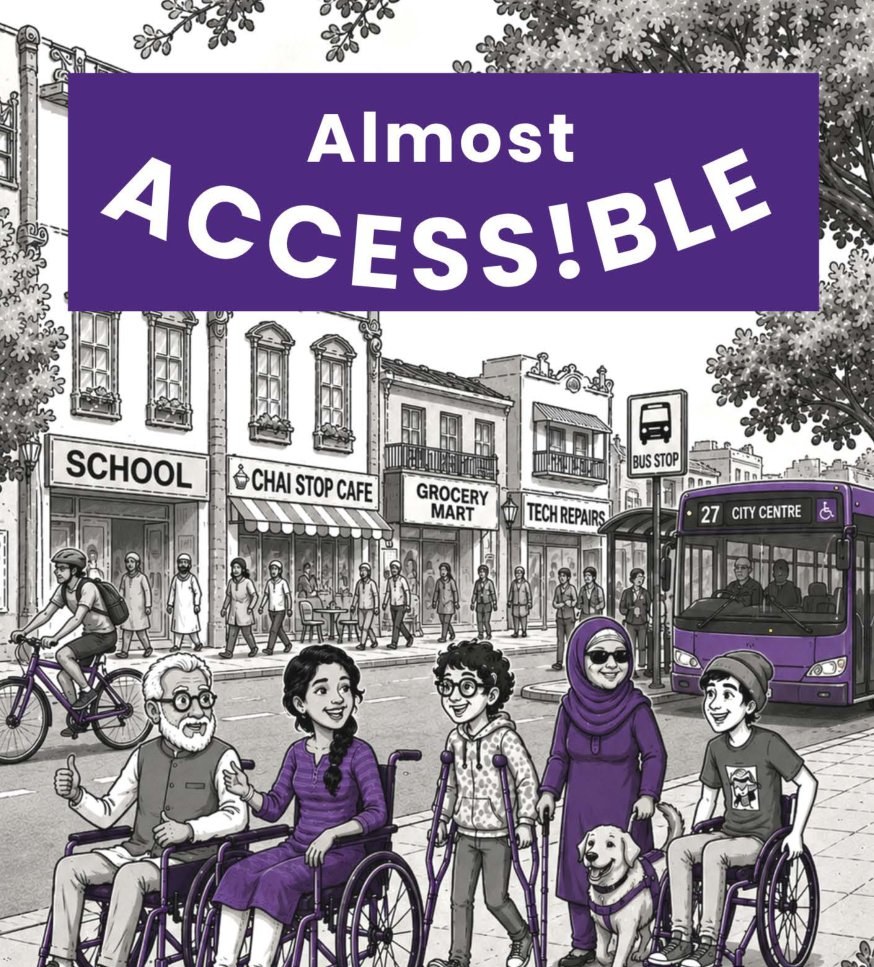
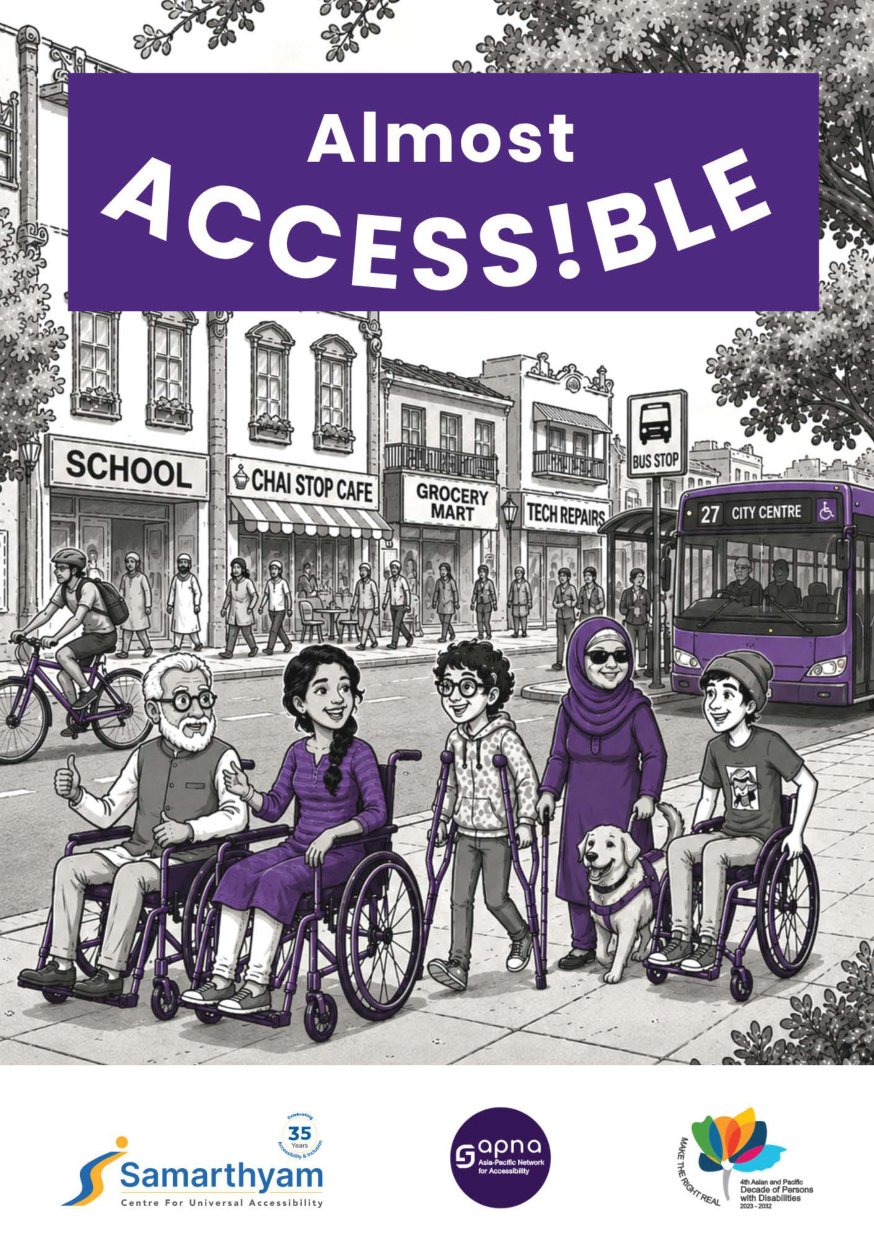
This is the cover page of a comic-style illustration titled “Almost Accessible” in bold white letters on a purple banner.
Below the banner is a group of cheerful people with diverse disabilities moving together along a city pavement. There are three wheelchair-users – two are leading the group, one person is walking with crutches. Bringing up the rear is a Blind person holding the harness of a healthy and happy guide dog, and walking with the third wheelchair-user. They appear engaged in animated conversation, smiling and interacting warmly.
The background features small shops such as a bookstore, café, grocery store, and tech repair shop, along with a bus stop, suggesting a typical urban neighbourhood setting. Despite the warm vibe, the title implies that the environment may not be fully accessible. At the bottom of the page are the logos of Samarthyam – Centre for Universal Accessibility, APNA (Asia-Pacific Network for Accessibility), and the 4th Asian and Pacific Decade of Persons with Disabilities, 2023–2032.
“Many of the innovations we use everyday, from captions on videos to voice assistants and automatic doors, were developed with accessibility in mind. When we design for inclusion, everyone benefits. Accessibility is not a favour for a few; it is an investment that improves lives for all.”
Emmanuel Offorjama, Disability Inclusion Advocate, Ibadan, Nigeria
Almost Access!ble Comic Book: APNA publication, first edition.
© APNA 2026. All rights reserved. No part of this comic book may be reproduced, copied, distributed, or used in any form without prior written permission from APNA.
Disclaimer
The humour in this comic book is aimed at highlighting inaccessible systems and environments, and related ableist attitudes. It is not the intention to make fun of persons with disabilities. The stories and illustrations are designed to spark reflection on the everyday barriers many people continue to face. Any resemblance to real-life spaces or situations is intended to encourage awareness and positive change and not to mock any disability type or condition. The production team endeavoured to make this comic book accessible and easy to read.
The illustrations are based on the lived experiences of persons with diverse disabilities, and accessibility audits conducted by experts with diverse disabilities.
Designer
Contributors
Contributors are listed by the alphabetical order of their personal names. The sequence does not reflect the magnitude of contributions made.
- Aarushi G.
- Abha Khetarpal
- Ai Kawamura
- Aloka Guha
- Amar-Singh HSS
- Anjlee Agarwal
- Anthony Chong
- Benita Gurung
- Debabrata C.
- Della L.
- Dipendra Manocha
- Dulamsuren (Duya) Jigjid
- Dwi Ariyani
- Geetam Tiwari
- Gita B.
- Haimantee B.
- Huma Masood
- Inise Tawaketini
- Ipul Powaseu
- Joanna Lee
- Joseph Kwan
- Judy Wee
- Kalpana V.
- Laxmi N.
- Monique G.
- Manjima D.
- Moses Choo
- Namrata Mehta
- Naziaty Mohd Yaacob
- Nidhi Madan
- Pam Rajput
- Patrick Ang
- Pema Chhogyel
- Radhika G.
- Rajvi Mehta
- Sangita T.
- Saowalak Thongkuay
- Sarika P.
- Satoshi Kose
- Shalini K.
- Somchai Rungsilp
- Sor San
- Sovaia
- Stuti N Kacker
- Suprava D.
- Thitiphorn P.
- Tika D.
- Veneranda M.
- Yoshihiko Kawauchi
- Yuenwah San
- Zian Cao
About Almost Access!ble
Accessibility is often invisible, noticed only when it is missing. A step too high, a narrow doorway, an unreadable menu, or an unusable washroom … these everyday design gaps quietly determine who gets to participate and who is left out. Not by intent, but by design.
The “Almost Access!ble” comic book portrays these lived realities as relatable, on-the-ground scenarios. Through visual storytelling, it highlights the common barriers that people face while navigating everyday spaces like streets and public venues. It moves beyond awareness to understanding and helping professionals, businesses, service providers, and communities recognize what accessibility truly means in real-life contexts.
For millions in the Asia-Pacific region, inaccessibility limits participation in meaningful experiences. This is not about perfection. It is about progress, asking better questions, making better choices, and designing spaces where everyone feels welcome and safe.
Because going out should be accessible for everyone. Let’s do Ctrl + Alt + Delete barriers. Time to reset the system.
Foreword
Disabled persons’ participation on an equal basis with others is enshrined in the Convention on the Rights of Persons with Disabilities (CRPD). As of 20 May 2026, 85 per cent of the 193 governments in the membership of the United Nations have signed the Convention.
For the past 30+ years, the membership of the United Nations Economic and Social Commission for Asia and the Pacific (ESCAP), with 62 governments since 2003, led all regions of the world by proclaiming four consecutive Decades focusing on promoting awareness and action on the rights of persons with disabilities.
Equitable accessibility for all, with appropriate and affordable assistive devices for independence and safety in daily life — is central to fulfilling the promise of the four Decades for over 750 million persons with disabilities in the ESCAP region:
- CRPD: art. 9 Accessibility, and in the Preamble, art. 3 General Principles, and art. 31 Statistics and data collection;
- Incheon Strategy to “Make the Right Real” for Persons with Disabilities in Asia and the Pacific: Goal 3 Enhance access to the physical environment, public transportation, knowledge, information and communication;
- Operational Guide on the Implementation of the Jakarta Declaration on the Asian and Pacific Decade of Persons with Disabilities, 2023–2032: Priority Area 3: Improve physical and digital accessibility with special attention to the distinct needs of persons with different disabilities and of women, children and older persons with disabilities.
Yet, with some exceptions, barriers still abound in much of the ESCAP region. Those barriers impede disability-inclusive access to all aspects of life on an equal basis with others.
The Decade initiative yielded many opportunities for mutual learning and transformative action. One umbrella for those opportunities was the ESCAP project on the Promotion of Non-handicapping Environments. It had pilot projects in Bangkok, Beijing and New Delhi. Linked with that was another ESCAP project on training persons with disabilities for leadership roles, including in access promotion.
Anjlee Agarwal is a distinguished member of the ESCAP family of participants, resource persons and allies who bonded over a shared passion for promoting disability-inclusive accessibility.
It is remarkable that, along with new names, there are names from those early days of the journey for accessibility (1990s and early 2000s) that appear in the list of contributors to this comic book.
In addition to Anjlee herself, the early stalwarts of access promotion in their respective fields of expertise who contributed to this book include: Dipendra Manocha, Naziaty binti Mohd Yaacob, Judy Wee, Satoshi Kose and Joseph Kwan.
Over 30+ years, there have been many attempts to provide some form of accessibility in physical infrastructure, public transport and ICT systems. However, there is still a need for sensitization regarding what accessibility means from user perspectives. Hence, there is a lag in the understanding and drive for correct action towards accessibility. This comic book aims to bridge that gap by building empathy and fostering understanding among persons with diverse disabilities, as well as other key actors.
Barriers to access are no laughing matter. Why a comic book? The answer lies in Anjlee’s own words:
“The idea for this e-comic book emerged from a simple gap we kept encountering. As accessibility professionals, advocates and auditors, much of our work is grounded in technical standards and detailed frameworks – essential, but limited in reach and real-world implementation.
We wanted a way to engage beyond the usual circle of ‘hardcore’ professionals. The comic format offers an entry point – especially for young professionals, decision-makers new to accessibility, personnel of implementing agencies, and a wider group of key actors, namely, anyone involved in translating policy and design into on-the-ground reality. And, to achieve this by presenting accessibility issues in a more relatable and human way, to prompt reflection.
Through humour and storytelling, we hope that this comic book opens up space to think, question, and connect with everyday barriers in a way that technical documents cannot.
It is designed to resonate across audiences – school children, college students, vocational education trainees, those attached to CSOs, OPDs and government departments and ministries – making accessibility not just understandable, but also engaging and thought-provoking.
My hope is that this comic book becomes a powerful catalyst — something that sparks an immediate realization of how barriers in our physical, digital and information ecosystems exclude persons with disabilities. So that accessibility is treated as an integral part of planning, design and implementation. And, no longer just an afterthought or a box to be ticked off.
My team and I – we – see this comic book as a versatile tool that could be used across contexts: in training programmes, capability-building workshops, classrooms in schools, colleges and training centres, and even in design practice. We hope that it prompts people to actively think about accessibility in their everyday lives.
We seek to engage younger students to encourage early empathy and build awareness, especially in the context of buddy systems and inclusive practices being introduced in schools for students with disabilities.”
In that vein, students from architecture, planning, engineering, and design institutions would particularly benefit. This comic book could inform both academic studio work and future professional practice – to help in thinking beyond the drawing board to on-the-ground implementation, and avoid barriers highlighted in the comic book.
Anjlee and I agree that the biggest untapped potential for improving a track record on accessibility lies in people who are mainly trained in technical and vocational education institutions and CSO-run vocational training centres:
- Civil, construction and site technicians: These include diploma holders, site supervisors, masons, plumbers. They decide on the location of ramps and rails, ramp gradients, toilet layouts, door widths and the direction that doors open.
- Electricians and lift or escalator technicians responsible for the proper placement of switches, audio-visual indicators, alarm systems. They also see to the maintenance of lifts, tactile buttons and Braille markings, and voice announcements.
- Fabricators, carpenters and product technicians: They build what people interact with: accessible furniture, counters, classroom, workplace and service counter layouts. They retrofit handrails, grab bars, and modular ramps. They have a lot to do with low-cost assistive devices and adaptations at the level of ground reality.
- Digital and IT support technicians responsible for entry, content uploads (often they destroy accessibility without realizing it). Their duties include app testing, basic user interface (UI) adjustments, document formatting, and ensuring PDFs, forms and kiosks are screen-reader friendly.
- Graphic designers, print and media technicians have a huge, yet to-be-fulfilled responsibility for the disability-inclusive impact of readable fonts, colour contrast, and simple layouts. Their work impacts the production of captioning videos, integrated description for training and other educational materials, as well as converting content into multiple formats (e.g., audio and large print), and preparing easy-to-understand materials.
- Transport and mobility operators, among whom are drivers, conductors, station and terminus staff (including cleaners), logistics handlers — they are the gatekeepers for first and last mile accessibility. Boarding and disembarking assistance, communication of public transport-related information, handling mobility devices, keeping accessible toilets from being locked or used as storage rooms — they make public transport systems actually usable, not just “accessible on paper.”
- Retail, leisure and hospitality service staff include frontline workers in malls, restaurants, food courts, parks, entertainment venues and hotels.
- Healthcare and rehabilitation support staff include technicians, assistants, community health workers who interface daily with persons with disabilities.
Furthermore, all of the abovementioned could enable dignity by facilitating communication, and supporting the monitoring of the usability of facilities.
This comic book is for all whose roles and duties directly impact the experiences of persons with disabilities in:
- Using the street and built environment, and public transport;
- Navigating the digital universe;
- Accessing services and systems related to any aspect of the built environment, street environment, public transportation and the digital environment.
This comic book was prepared with the following in mind: officials at all levels, branches and locations of government, including public works, urban planning, rural development, public transport, digital economy, multimedia communication and ICT entities responsible for infrastructure and service delivery. It also includes planners, architects, engineers, contractors, designers and content creators.
Equally, this comic book is for private sector stakeholders, project managers, facility managers, accessibility champions of CSOs and OPDs – all who influence design, execution and operations.
The core message of this comic book is powerful:
- We are not disabled because of who we are.
- We are disabled by the environment, systems, institutions, policies, SOPs and processes that are not CRPD-compliant because of ableism and insufficient action against it.
Through our Decade efforts, we tried conventional ways of raising awareness and technical understanding to remove access barriers. In a new way of promoting accessibility awareness, please join five friends who champion accessibility. Together, let us embark on a fresh chapter of our collective journey for accessibility in the ESCAP region – with humour and creative joy.
I warmly congratulate the Samarthyam team who worked hard to produce this comic book using in-house resources and pro bono contributions. This is a dynamic work in progress and the team is open to feedback. Perhaps we could welcome new friends to join in this journey – particularly friends with non-visible disabilities.
Message
It is a pleasure to present “Almost Accessible,” an impactful comic book that uses humour to highlight the everyday barriers faced by persons with diverse disabilities while promoting the importance of accessibility and inclusion. Through engaging stories and relatable characters, this publication encourages readers to view accessibility from a new perspective and reminds us that creating an inclusive society is a shared responsibility. Accessibility is not only about removing barriers but also about fostering dignity, equality, and full participation for all.
Message

Warm congratulations to Samarthyam and the Asia-Pacific Network for Accessibility on the publication of the “Almost Access!ble” comic book. This work offers a vital and innovative approach to accessibility advocacy, moving beyond conventional technical frameworks to foster deep understanding and empathy. By grounding complex issues in relatable, everyday scenarios, this comic serves as an essential bridge between policy design and on-the-ground reality, helping a wide range of stakeholders see the visible and hidden barriers faced by persons with disabilities.
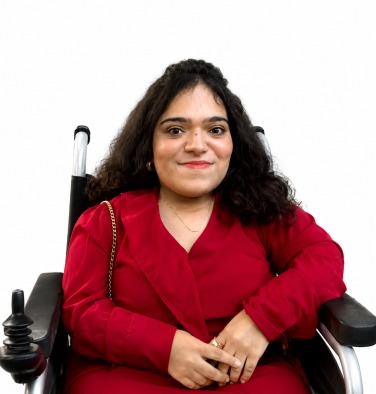
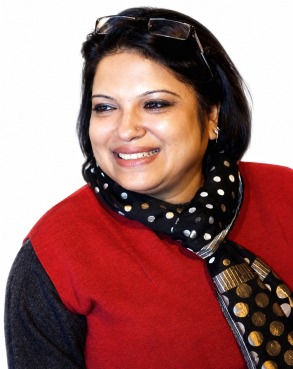
I particularly appreciate the collaborative spirit behind this project. The comic book was designed by a communications professional with disabilities, and thoughtfully shaped by a diverse group of experts — with and without disabilities. By illuminating the barriers that persist in our physical and digital environments, as well as in information and communications, it challenges the complacency and ableist attitudes that often hinder progress. In doing so, it encourages service providers, businesses, communities and policy makers to recognize their roles and shared responsibilities in creating truly inclusive spaces.
This publication serves as a powerful contribution to the Asia-Pacific regional agenda, particularly by supporting the implementation of the Jakarta Declaration on the Asian and Pacific Decade of Persons with Disabilities, 2023–2032.
It reflects the priorities of the Decade, which underscores the necessity of improving physical and digital accessibility so that persons with disabilities can participate fully and equally in all aspects of society. I commend this initiative for its creativity, its regional roots, and its commitment to turning the vision of the Asian and Pacific Decade of Persons with Disabilities into a reality.
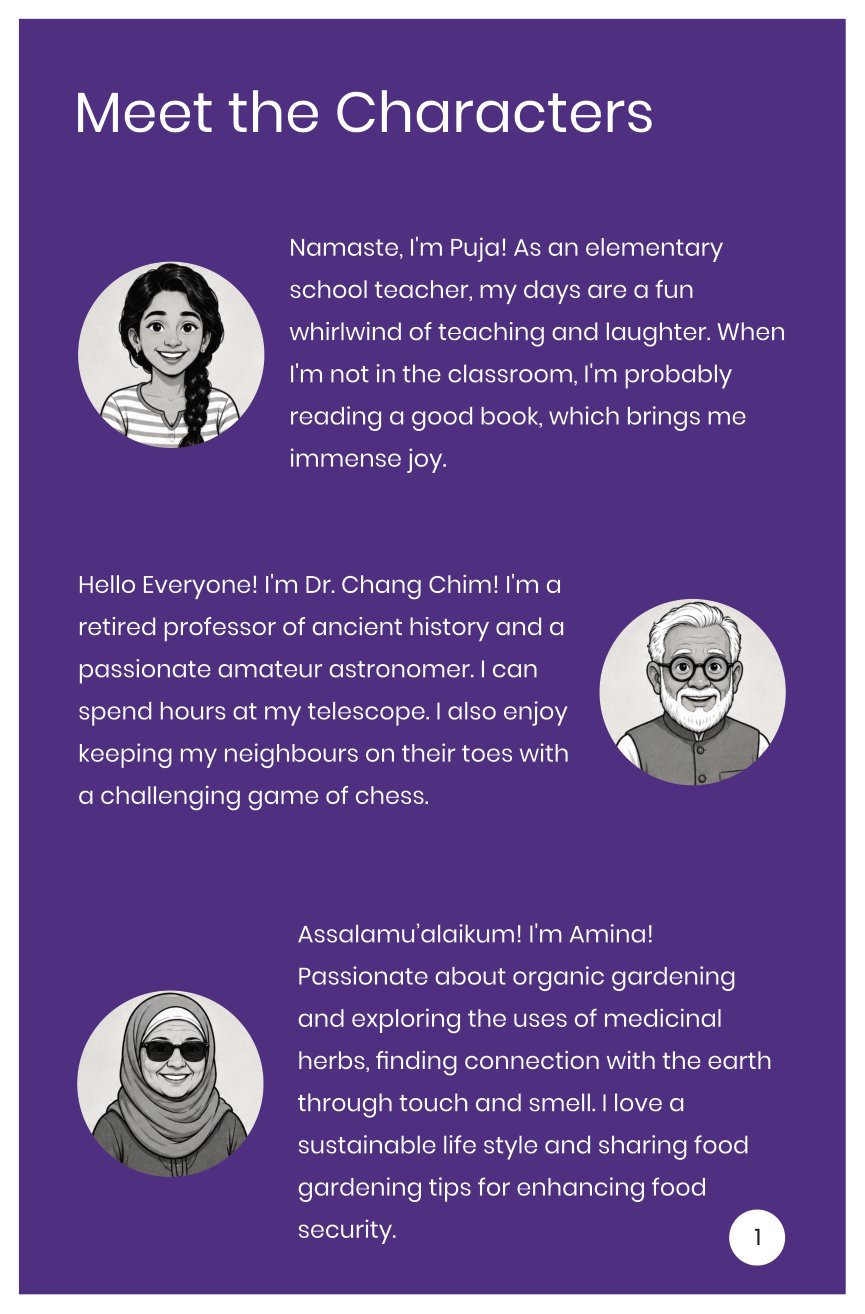
Puja is a young woman who wears her thick black hair in a braid down the front of her striped t-shirt, and a cheerful smile that shows her gleaming white teeth. She says, “Namaste, I’m Puja! As an elementary school teacher, my days are a fun whirlwind of teaching and laughter. When I’m not in the classroom, I’m probably reading a good book, which brings me immense joy.”
Respected Dr. Chang Chim, with thick white hair, eyebrows and beard, wears a traditional, high-collared jacket. He says, “Hello Everyone! I’m Dr. Chang Chim! I’m a retired professor of ancient history and a passionate amateur astronomer. I can spend hours at my telescope. I also enjoy keeping my neighbours on their toes with a challenging game of chess.”
Amina wears a bright smile, dark glasses and a hijab over her head. She says, “Assalamu’alaikum! I’m Amina! Passionate about organic gardening and exploring the uses of medicinal herbs, finding connection with the earth through touch and smell. I love a sustainable life style and sharing food gardening tips for enhancing food security.”
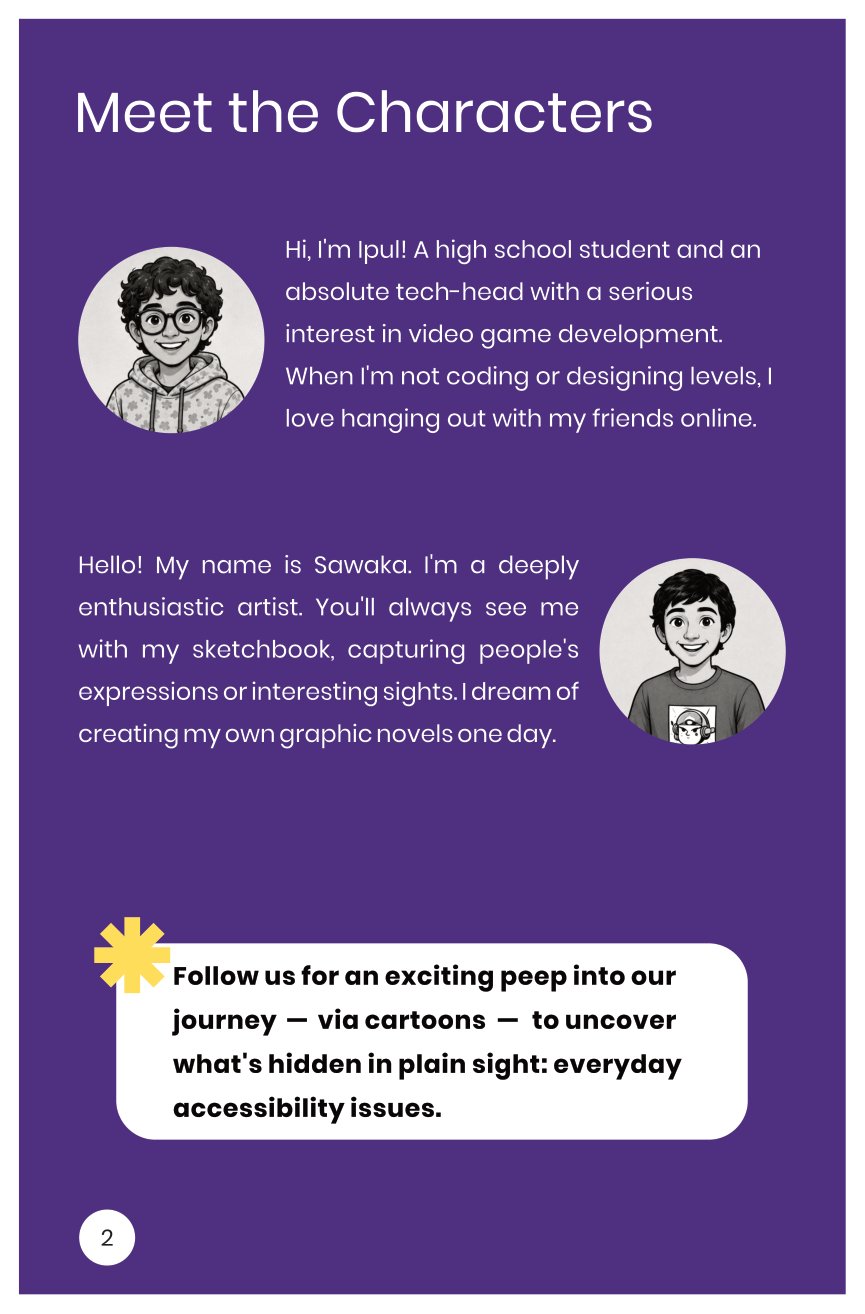
Ipul has curly dark hair, wears glasses with dark, round frames, and has a mole just below the left of his lower lip. And, Ipul is wearing a floral-patterned hoodie and an earring in his left ear lobe. He says, “Hi, I’m Ipul! A high school student and an absolute tech-head with a serious interest in video game development. When I’m not coding or designing levels, I love hanging out with my friends online.”
Sawaka’s dark hair tumbles over his forehead. He has a bright smile on his face and wears small brass ear rings on both ear lobes, a modern acknowledgement of his tribal roots. Sawaka’s t-shirt design suggests a funky art vibe. He says, “Hello! My name is Sawaka. I’m a deeply enthusiastic artist. You’ll always see me with my sketchbook, capturing people’s expressions or interesting sights. I dream of creating my own graphic novels one day.”
Follow us for an exciting peep into our journey — via cartoons — to uncover what’s hidden in plain sight: everyday accessibility issues.
Getting There
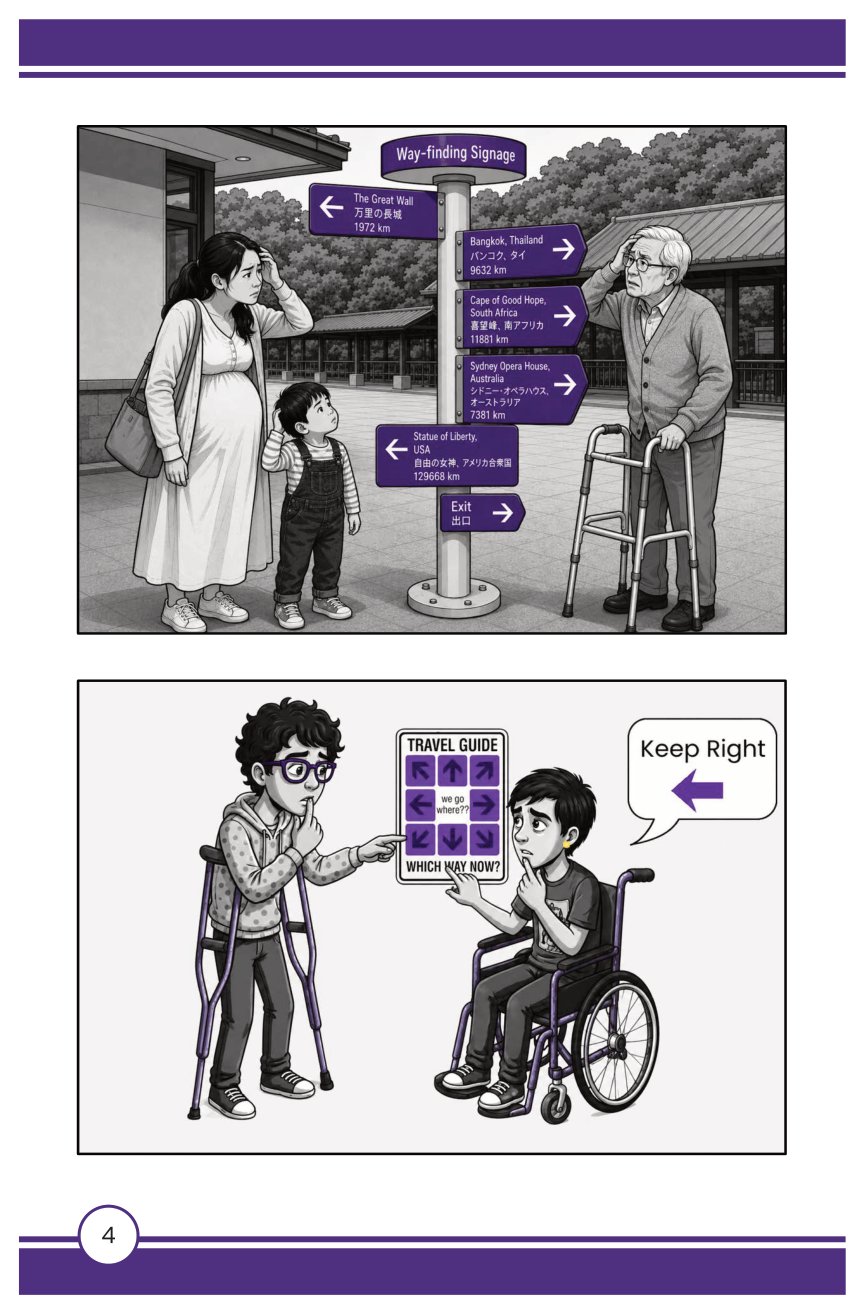
In an open outdoor public space, a pregnant woman with a bag on her right shoulder stands with her son in a bibbed jump suit in front of a tall way-finding sign post – both look confused. Attached to the post are six sign boards filled with information on destination names (e.g., The Great Wall; Bangkok, Thailand; Cape of Good Hope, South Africa; Sydney Opera House, Australia; Statue of Liberty, USA; Exit) in English and Japanese, with distances indicated. Across from the mother and son on the other side of the sign post, a bespectacled elderly man stands supporting himself using a walking frame. He looks equally puzzled, trying to make sense of the complex wayfinding signs.
In another scene below, two young people — one using crutches and the other in a wheelchair — struggle with unclear directional symbols on a travel guide board. Uncertain which way to go, they are further confused by a sign with text stating “Keep Right” which has an arrow under the text pointing in the opposite direction (to the left).
These examples highlight how poorly designed and wrongly-placed signage creates barriers that cause confusion, distress and inefficiency.
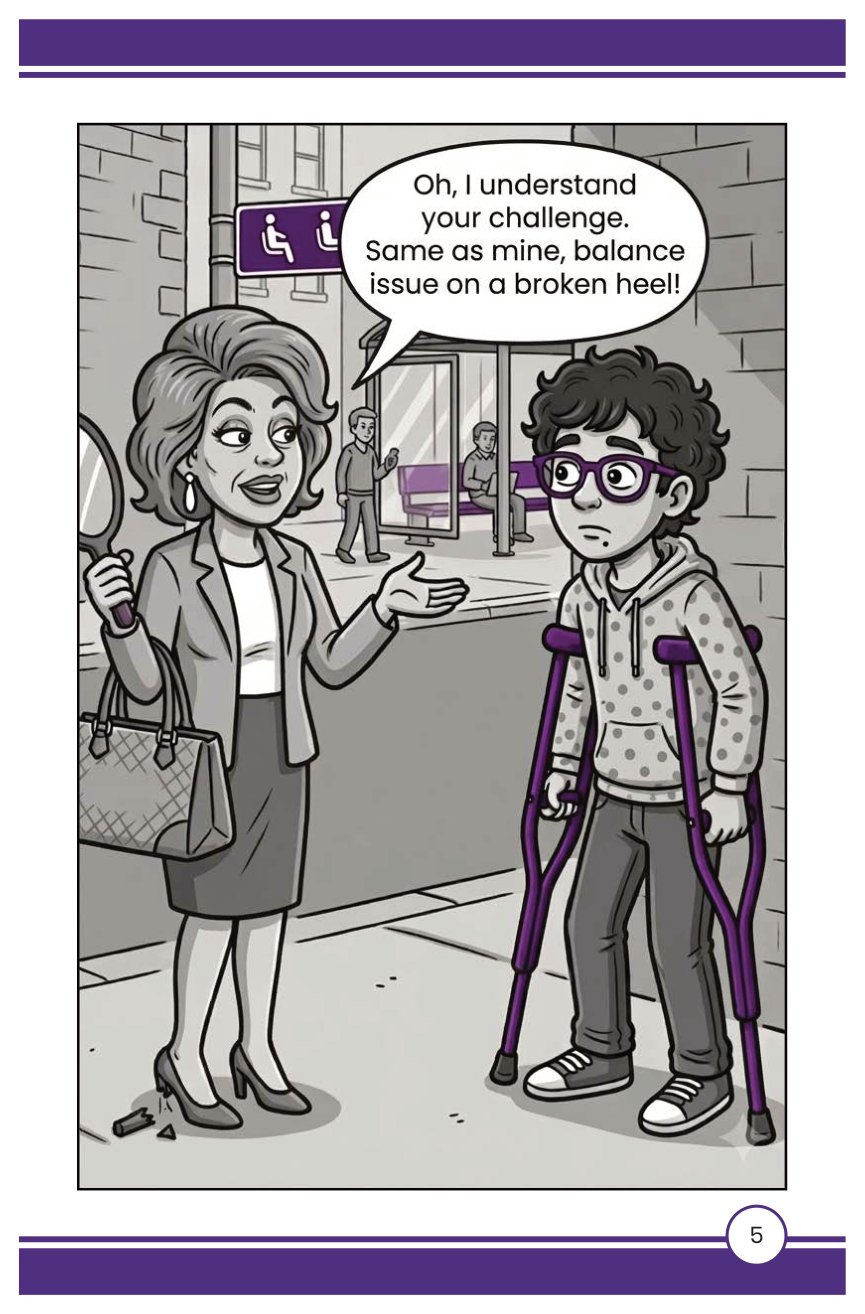
On a city street outside a public building with accessibility signage, people are moving in and out of a building, suggesting an everyday environment.
At a street corner, Ipul, who is using double crutches, stands listening, purple spectacle frames highlighting his wide-eyed astonishment … as a woman, with a big orange-dyed hairdo, long dangling ear rings, a large designer handbag in the crook of her arm, and wearing a knee-length western suit, talks down at Ipul. The three-inch heel of her right shoe is broken. Holding in her right hand a mirror that’s the size of her heavily-made-up face and gesturing “no big deal,” the woman says she understands his situation by comparing it to her discomfort of standing on a broken heel. She waves her left hand grandly, “Oh, I understand your challenge. Same as mine, balance issue on a broken heel.” The moment highlights disconnect — the woman’s ableist attempt at empathy, misunderstanding and wrong assumption regarding Ipul’s lived experience of disability.
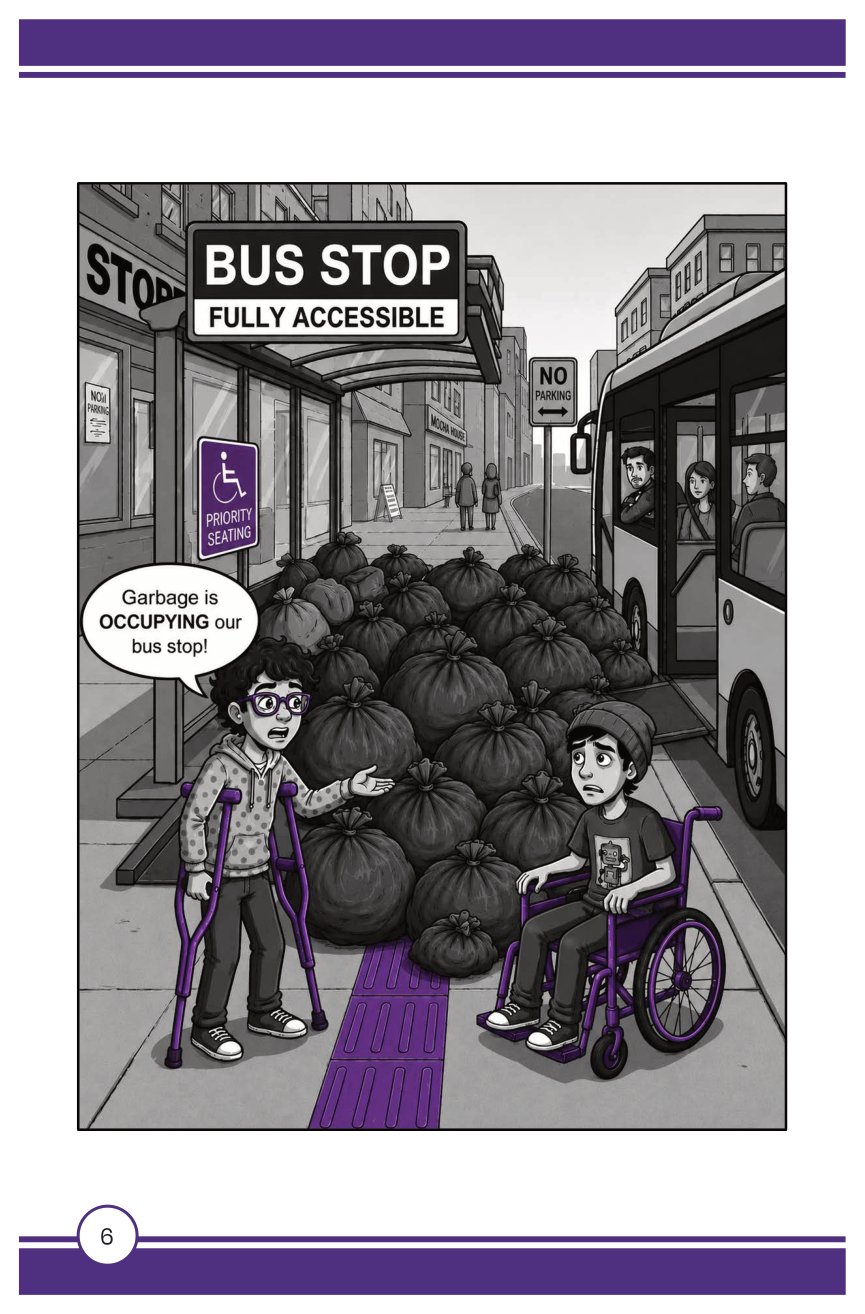
At a city street bus stop with a bold sign stating “BUS STOP – FULLY ACCESSIBLE,” Ipul and Sawaka encounter a reality that differs from the message on the sign.
Ipul, using double crutches, refers in horror to the bus stop and observes, “Garbage is OCCUPYING our bus stop!”
Sawaka, in his wheelchair, looks worried that a gigantic heap of full garbage bags is blocking the ramp and the access pathway marked for wheelchair users.
The bus has arrived. The driver and passengers inside are looking at Ipul and Sawaka, waiting for them to board the bus. However, the obstructed pathway makes boarding impossible.
In the background, a “Priority Seating” sign above the mountain of full garbage bags highlights the contrast between the promise and the reality of accessibility.
The barriers were created by poor design. The barriers were also the outcome of inadequate advocacy with the local community regarding the purpose of an accessible bus stop, as well as zero monitoring and enforcement to maintain the access facility for use by its intended target group: persons with disabilities.
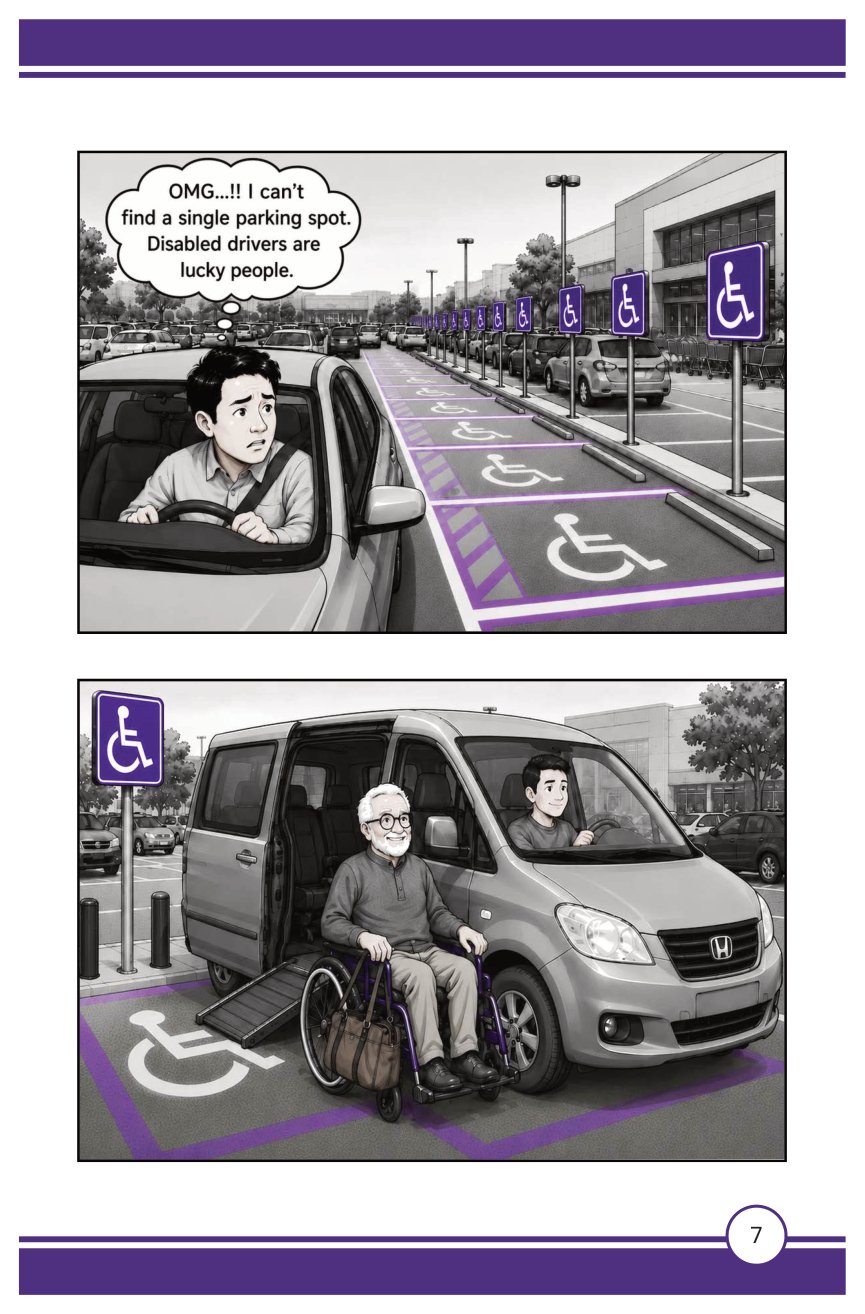
In a large parking area, a man in his car looks frustrated as he drives past slowly scanning rows of parking spaces marked with wheelchair symbols. In a thought bubble, he says, “OMG … !! I can’t find a single parking spot. Disabled drivers are lucky people,” misunderstanding the purpose of reserved parking spaces.
In the scene below, the perspective shifts: a van is parked in an accessible parking spot, with a ramp extended from the side door of the van. Dr. Chang Chim, using a wheelchair and holding a bag, has come down the ramp and is beside the front of the van, while the driver waits in the van. Both are looking at what is in front of them. The wide, clearly marked parking space, taken up by the wheelchair-accessible vehicle with ramp access, shows why it is necessary to have designated parking spaces for vehicles transporting persons with disabilities. This contrasts the gap between assumption and lived reality in an everyday setting.
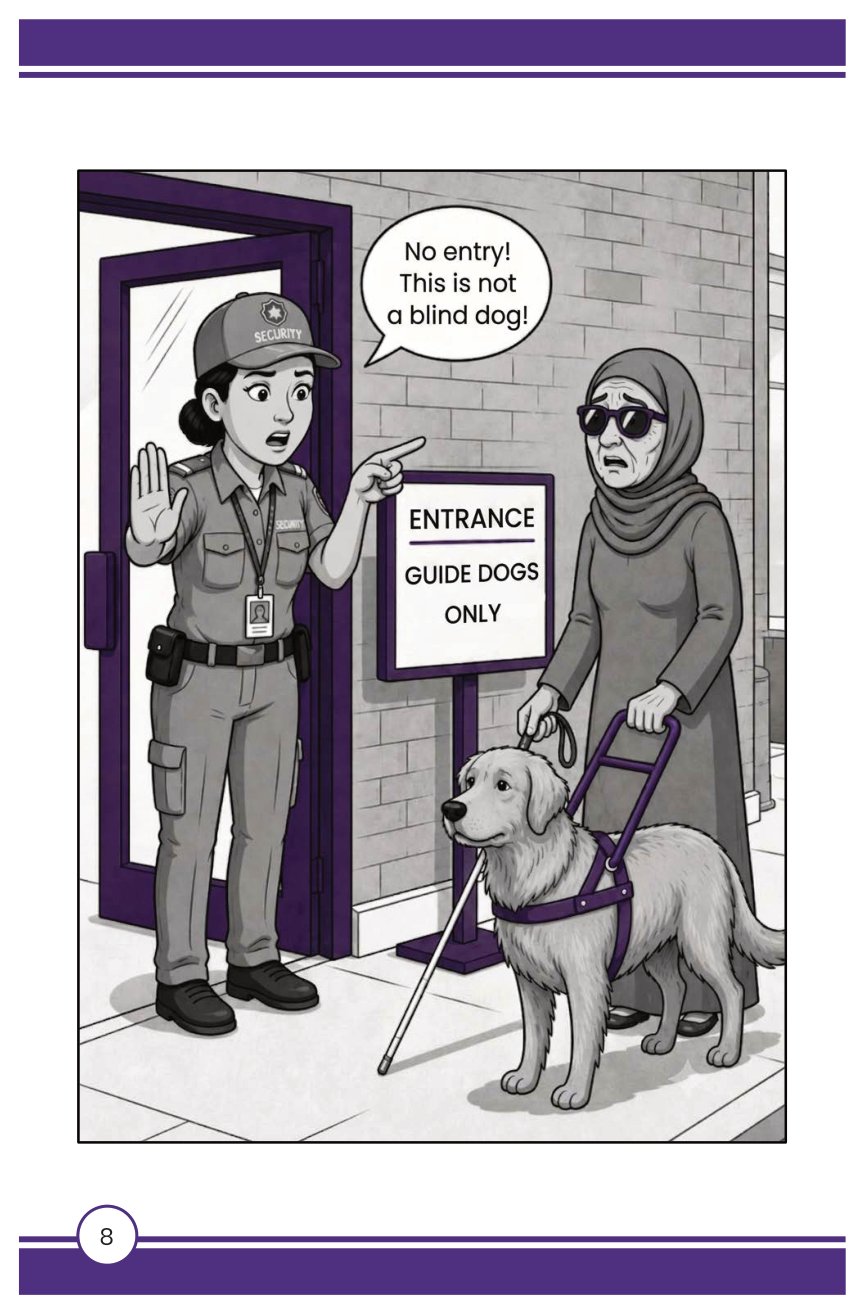
At a building entrance, a woman security guard stands at the doorway firmly stating, “No entry! This is not a blind dog!” She has raised her right hand, palm outstretched in a stop gesture and has pointed her left index finger at Amina who wants to enter the building. Amina is wearing dark glasses, using a white cane, and is accompanied by a guide dog whose harness Amina is holding. A large sign on the wall beside the entrance states “Entrance – Guide Dogs Only,” reflecting confusion in the understanding and messaging regarding accessibility.
Amina is taken aback and dismayed at being stopped by the verbal denial of entry, while her guide dog stands calmly by her side; it too knows that entry is not permitted.
This scene highlights a common misunderstanding regarding access and freedom of movement as the right of persons with disabilities on an equal basis with others, and the important role of service animals in this regard.
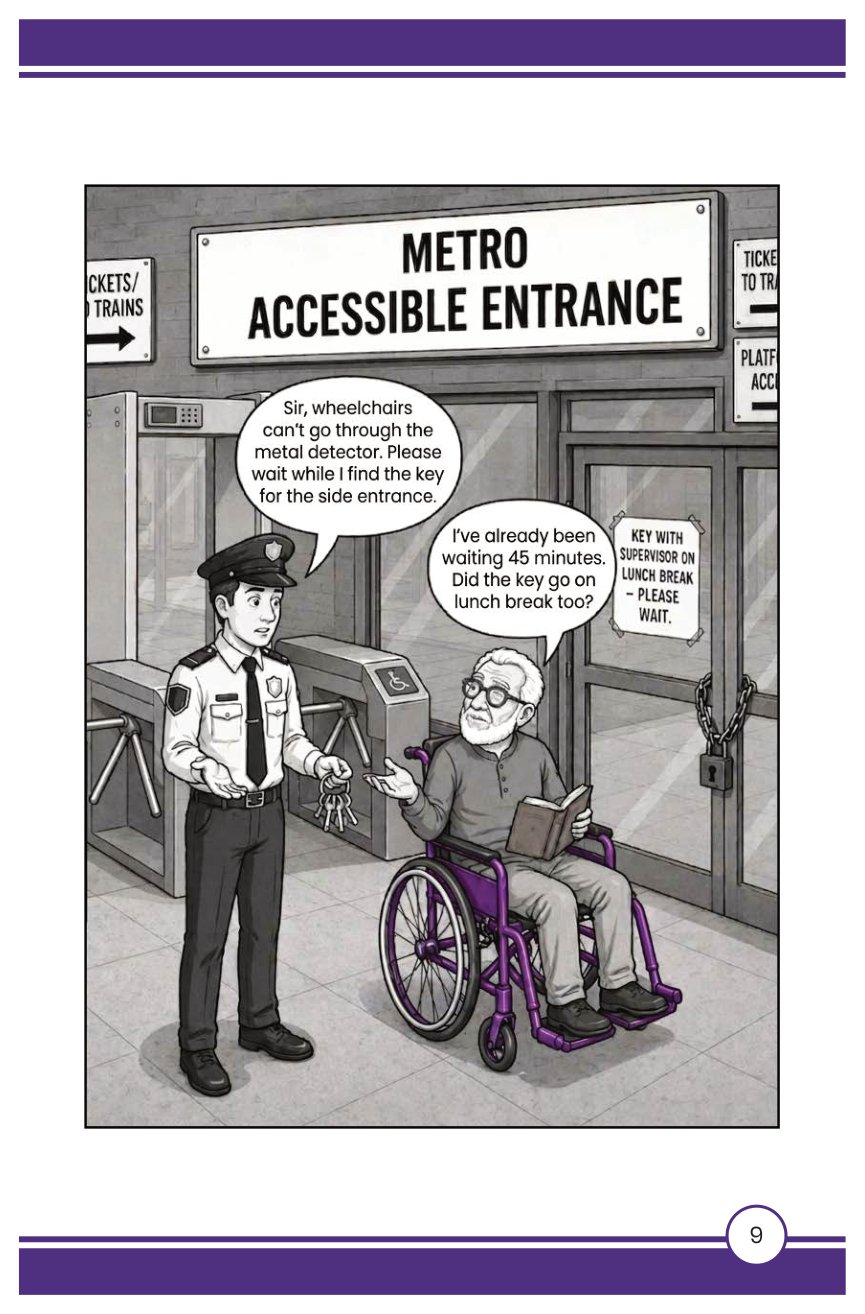
This picture of a transit station captures a systemic barrier under a large sign stating “METRO ACCESSIBLE ENTRANCE.”
In the foreground, Dr. Chang Chim, bespectacled, white-haired and sporting a neatly-trimmed white beard, sits in a purple wheelchair, holding an open book on his lap. Weary and a little exasperated, Dr Chang Chim looks up from his book at a young, uniformed male security officer. The officer holds out an empty right hand, palm up, with a helpless, apologetic gesture, while a bunch of keys dangle from a big metal ring in his left hand.
A speech balloon from the security officer reads: “Sir, wheelchairs can’t go through the metal detector. Please wait while I find the key for the side entrance.”
Dr. Chang Chim gestures back with an open hand, replying: “I’ve already been waiting 45 minutes. Did the key go on lunch break too?”
The wide glass door on the right of the picture reveals the irony of the situation. The wide glass side door — meant for wheelchair access — is firmly secured with a heavy chain and a padlock. Taped to the glass is a makeshift sign that reads: “KEY WITH SUPERVISOR ON LUNCH BREAK — PLEASE WAIT.”
The standard turnstiles and a security metal detector are working but are inaccessible, highlighting a system failure and service breakdown, despite the station’s official “accessible” branding.
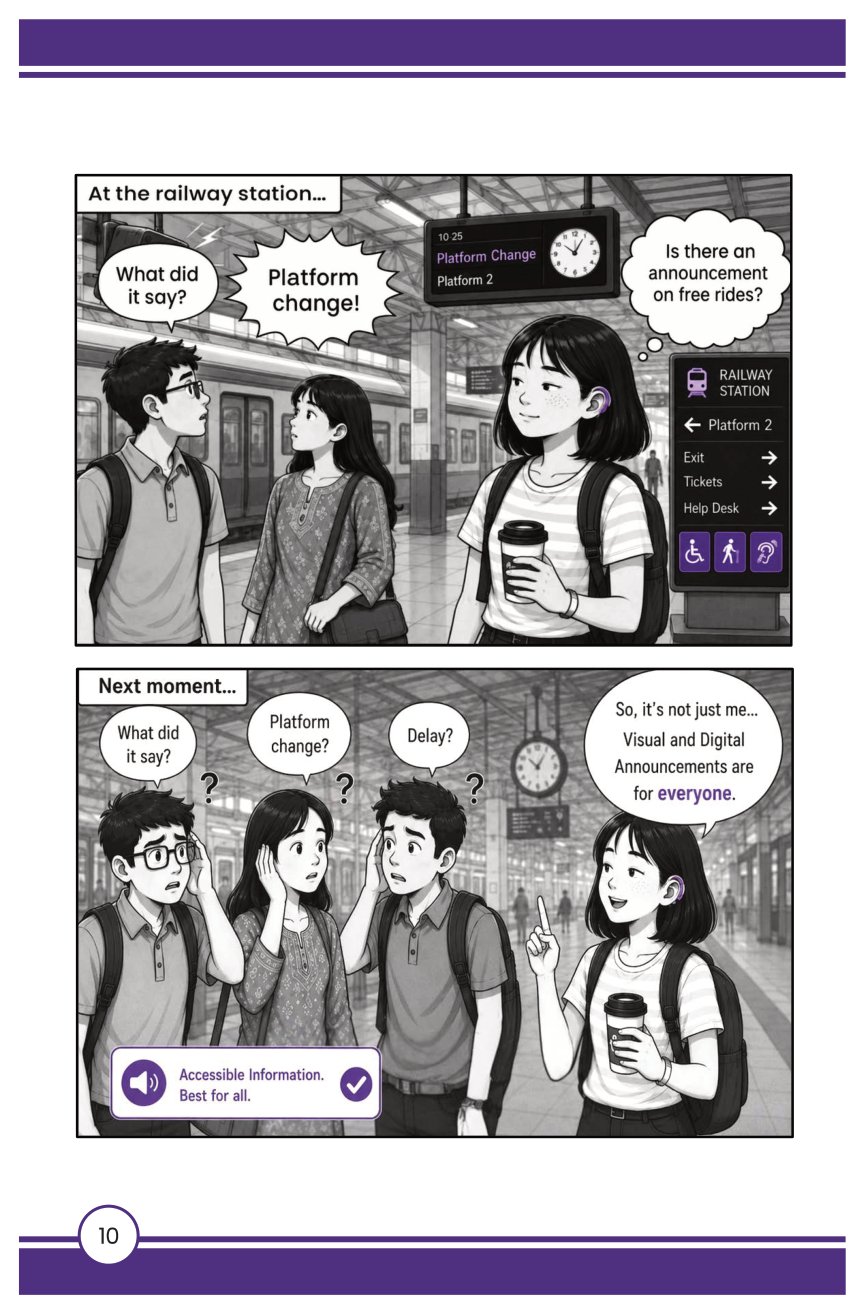
At a busy railway station with trains on both sides of a platform, a clock and directional signage, there is visual signage on Platform 2.
An audio announcement on “Platform change” leaves three hearing passengers unsure of what has just been announced. They turn to each other asking: “What did it say?” “Platform change?”
Nearby, a young woman wearing a hearing aid stands holding a disposable mug of beverage, not reacting to the audio announcement. She is thinking to herself that these three people are looking perplexed, might something be amiss that she needs to know? Is there an announcement on free rides?
In the next moment, the young woman gestures to the three persons and mouths, “So, it’s not just me … visual and digital announcements are for everyone.”
In a busy transit environment, for service-related announcements to be accessed by all, it is essential to convey the information clearly in easy-to-understand language, and in audio and visual formats.
Entering the Space
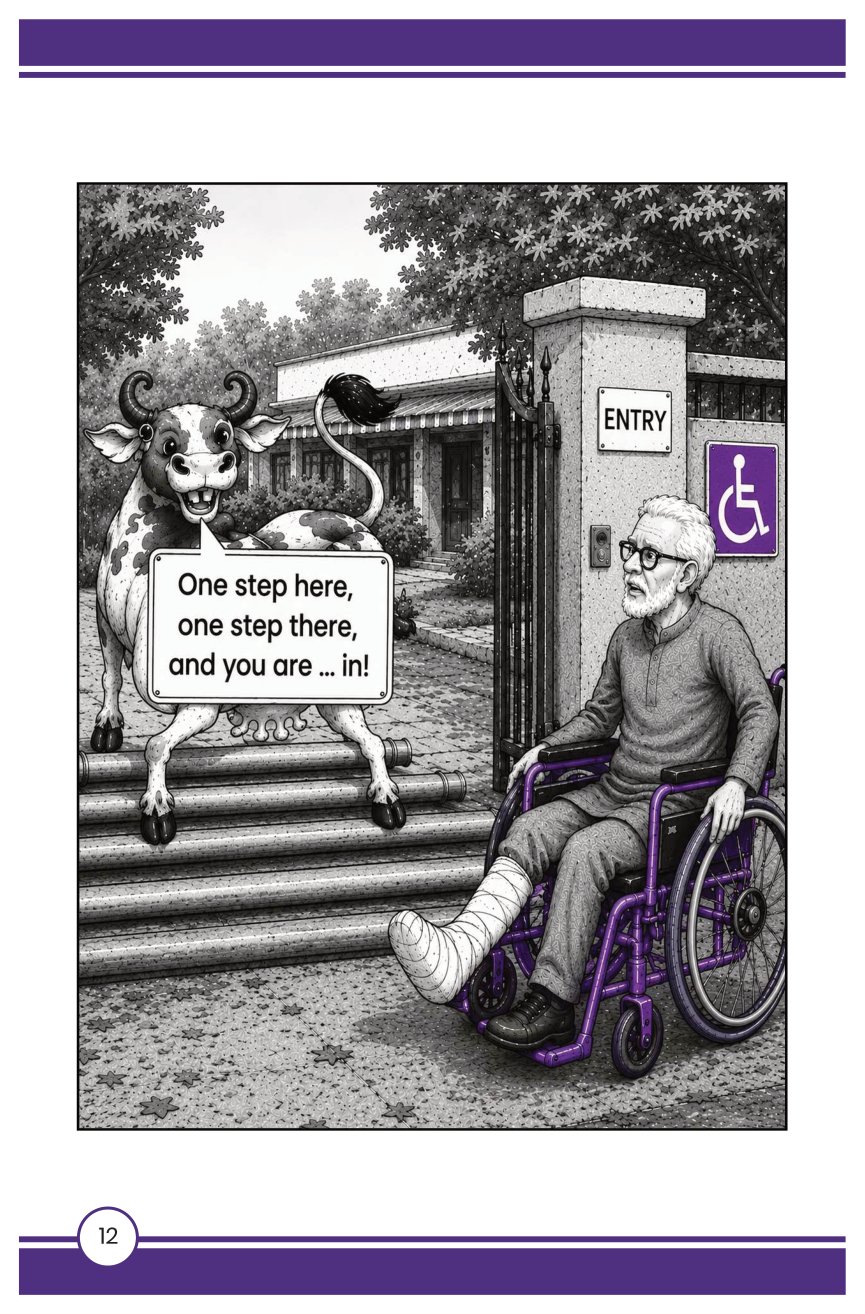
A satirical picture on a frustrating barrier to accessibility. Outside a building entrance — Dr. Chang Chim, bespectacled, white haired and white bearded, sits in a bright purple wheelchair. His right leg, tightly encased in a thick, white plaster cast, is extended straight out. He looks towards the entrance with an expression of sheer disbelief and exhaustion.
Directly in front of him, blocking the way, is a barrier on the ground in the form of a cattle grid (parallel metal pipes laid over a pit in the ground to stop animals from crossing it, but allowing vehicles and humans to walk over it). A cheerful, cartoon cow with a wide toothy grin is nimbly crossing the metal pipes of the cattle grid. A speech balloon from the cow reads: “One step here, one step there and you are … in!”
The grid is beneath an iron gate topped with an ornamental feature. The iron gate is attached to a sturdy concrete pillar with a prominent sign reading “ENTRY.” The wall extending from the concrete pillar has on it the access symbol (wheelchair user outlined in white on a purple background). Beyond the gate, a wide paved path leads to a single-storey building surrounded by trees and bushes.
This picture highlights the irony of an “accessible” entrance that is impassable for a wheelchair user, but perfectly easy for livestock that it was intended to keep out.
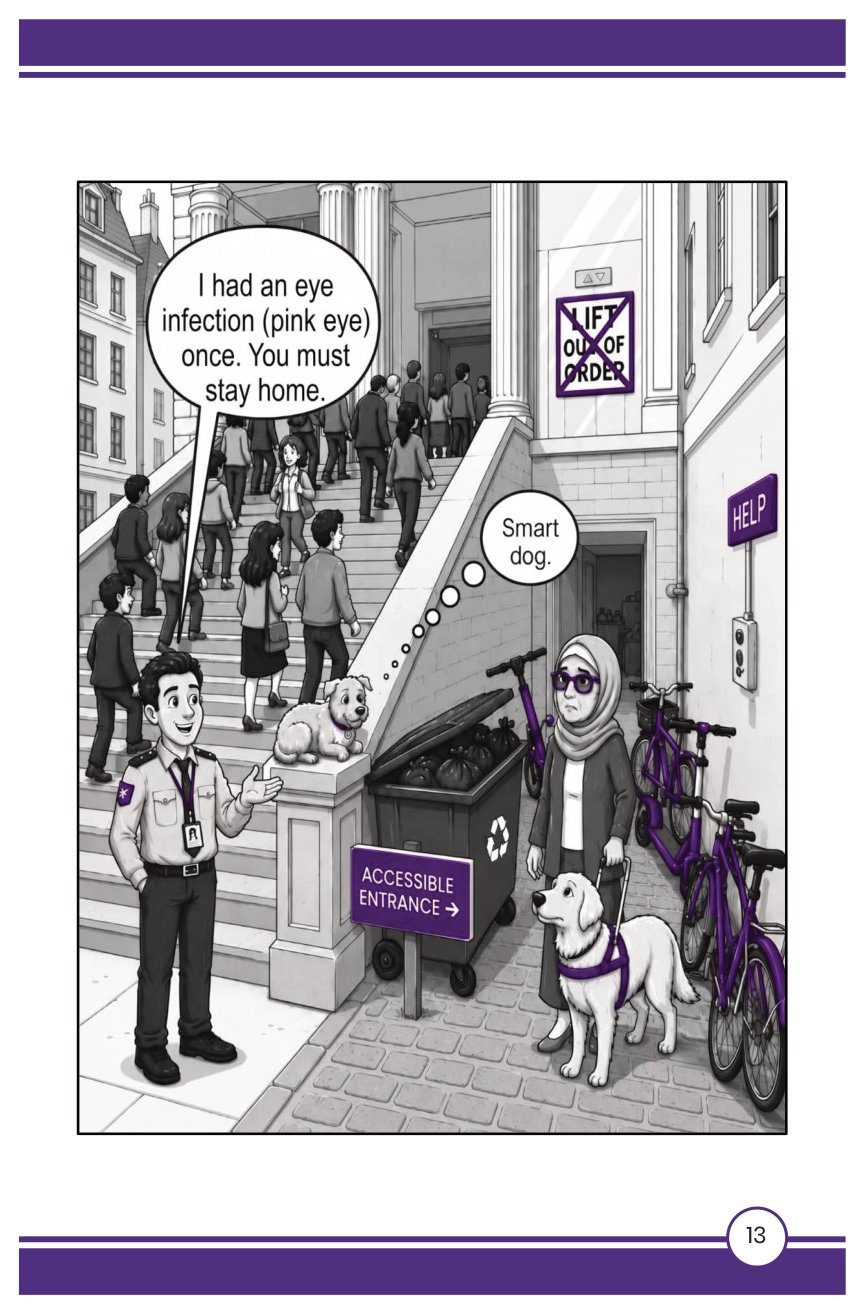
Amina, wearing dark glasses, hijab, elegant court shoes, a jacket over a top in a contrasting light colour and an ankle-length skirt that matches the jacket, stands with her white guide dog wearing a harness that she is holding on to. Amina has a disappointed and weary expression.
Addressing himself to Amina, while standing at the bottom of an imposing, steep staircase with many steps, is a young security guard in uniform, with a name badge. His speech balloon reads: “I had an eye infection (pink eye) once. You must stay home.”
Perched on a stone pedestal beside the guard, a well-fed dog watches the guide dog and thinks to itself, “Smart dog.”
This picture shows the complete failure of the building’s accessibility infrastructure. At the side of the large staircase, there is a sign indicating “ACCESSIBLE ENTRANCE” with an arrow, but the entire pathway to that entrance is completely blocked by a large wheelie bin stuffed with full, black garbage bags. In that narrow alley, there is also a row of parked bicycles, and an electric scooter. Directly behind this blocked pathway, there is an outdoor elevator marked with a large sign that reads: “LIFT OUT OF ORDER.”
Meanwhile, a large crowd of people walk up the wide, grand staircase leading to the building’s pseudo-Grecian-pillared entrance, underscoring how a thoughtless, inaccessible building design and an accessibility service breakdown segregate and exclude persons with disabilities.
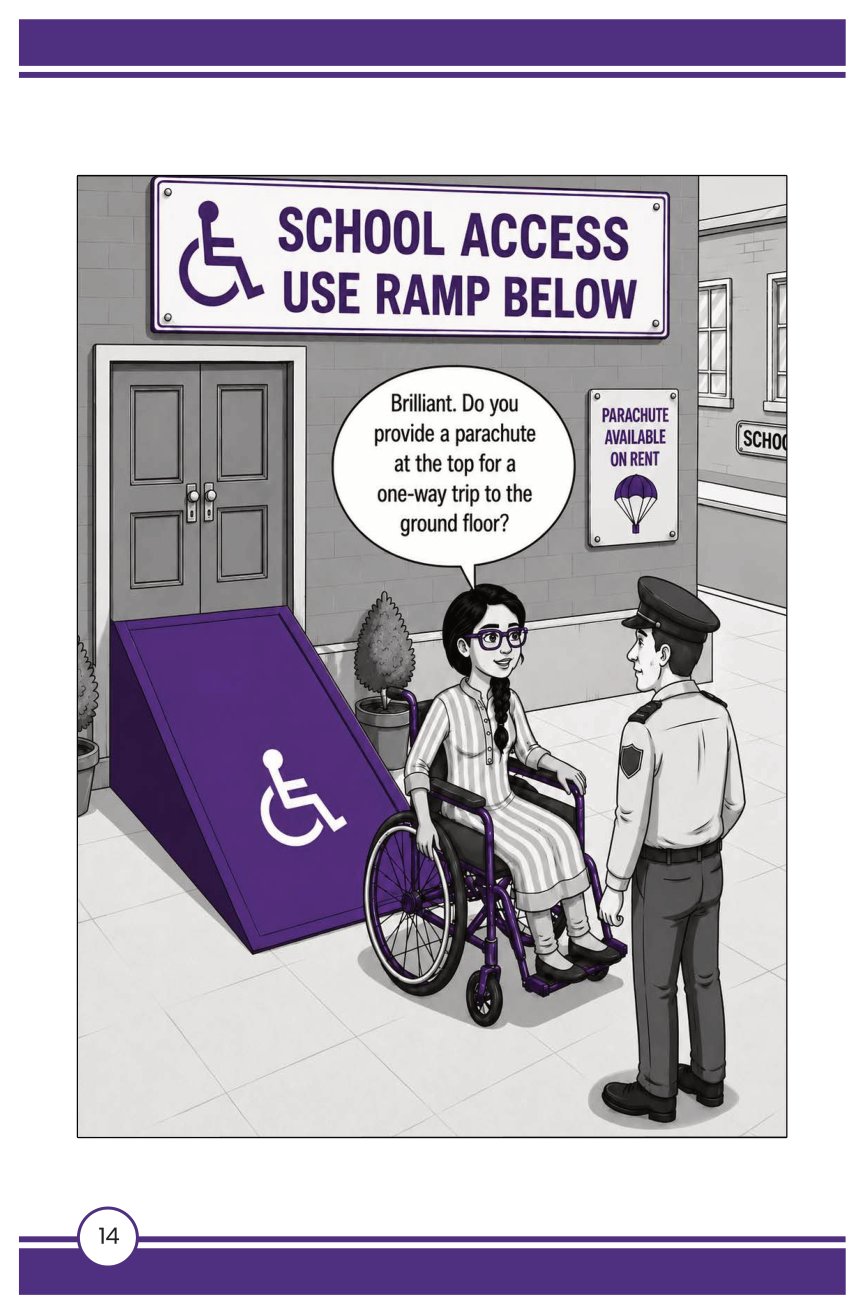
Puja, in a striped kameez and matching salwar, is in a wheelchair, her back to a dangerously steep purple ramp. Tongue-in-cheek, Puja asks the security guard if a parachute is available at the top of the steep ramp for a one-way trip to the ground floor — for wheelchair access.
The ramp leads directly to a wooden door with round brass door knobs. There is no landing or turning space in front of the door.
Above the door is a huge sign with the symbol for wheelchair access and huge upper-case letters proclaiming: “SCHOOL ACCESS. USE RAMP BELOW.” On the wall to the right of the door, a purple sign with a parachute icon reads: “PARACHUTE AVAILABLE ON RENT.”
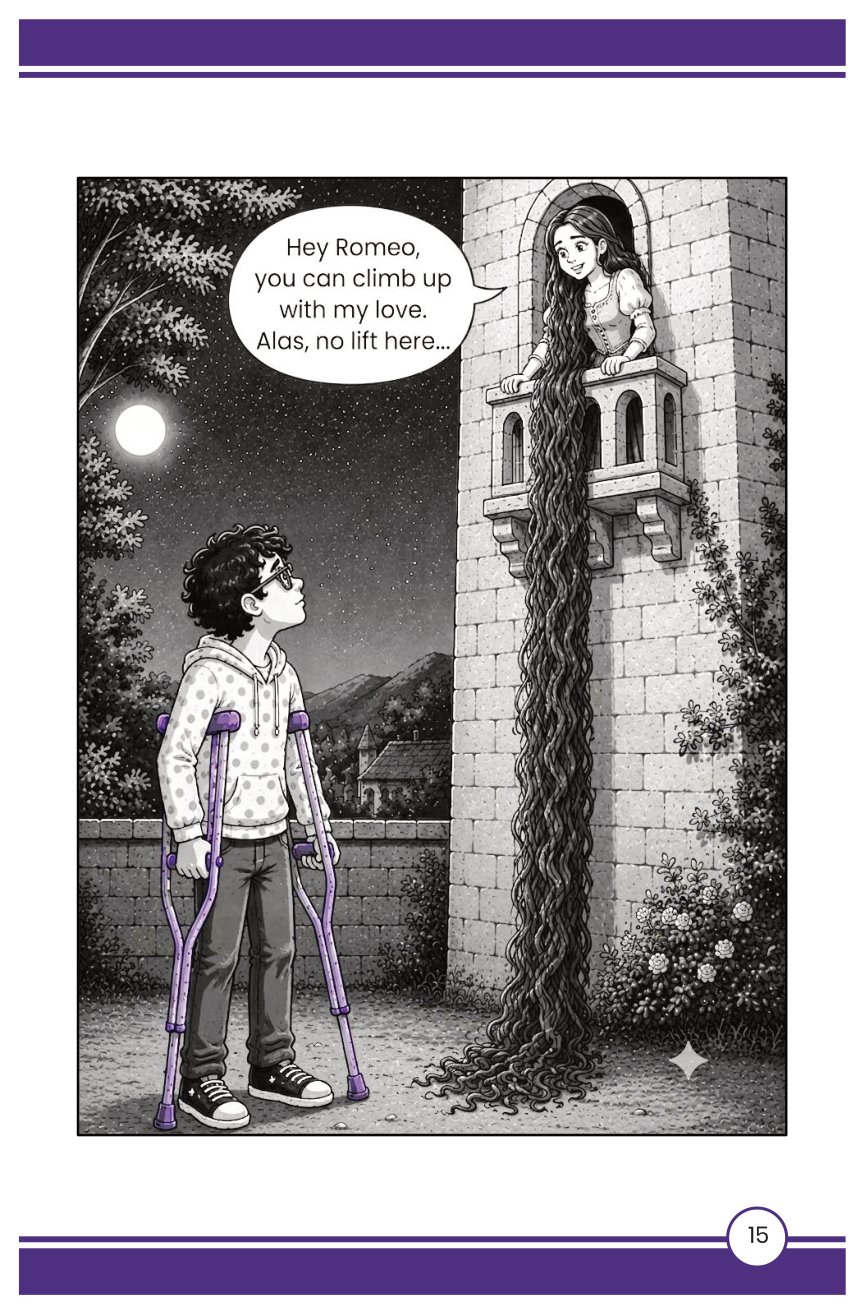
Puja’s luxuriant dark hair tumbles to the ground over the upper floor balustrade where she is leaning out to address Ipul, “Hey Romeo, you can climb up with my love. Alas, no lift here …”
Ipul gazes up at Puja, his purple double crutches gleaming in the bright moonlight under a star-studded sky, with nocturnal floral fragrance in the air and trees swaying in a soft breeze.
Ipul is tempted into wondering about climbing up the thick curls of Puja’s hair to her upper floor balcony.
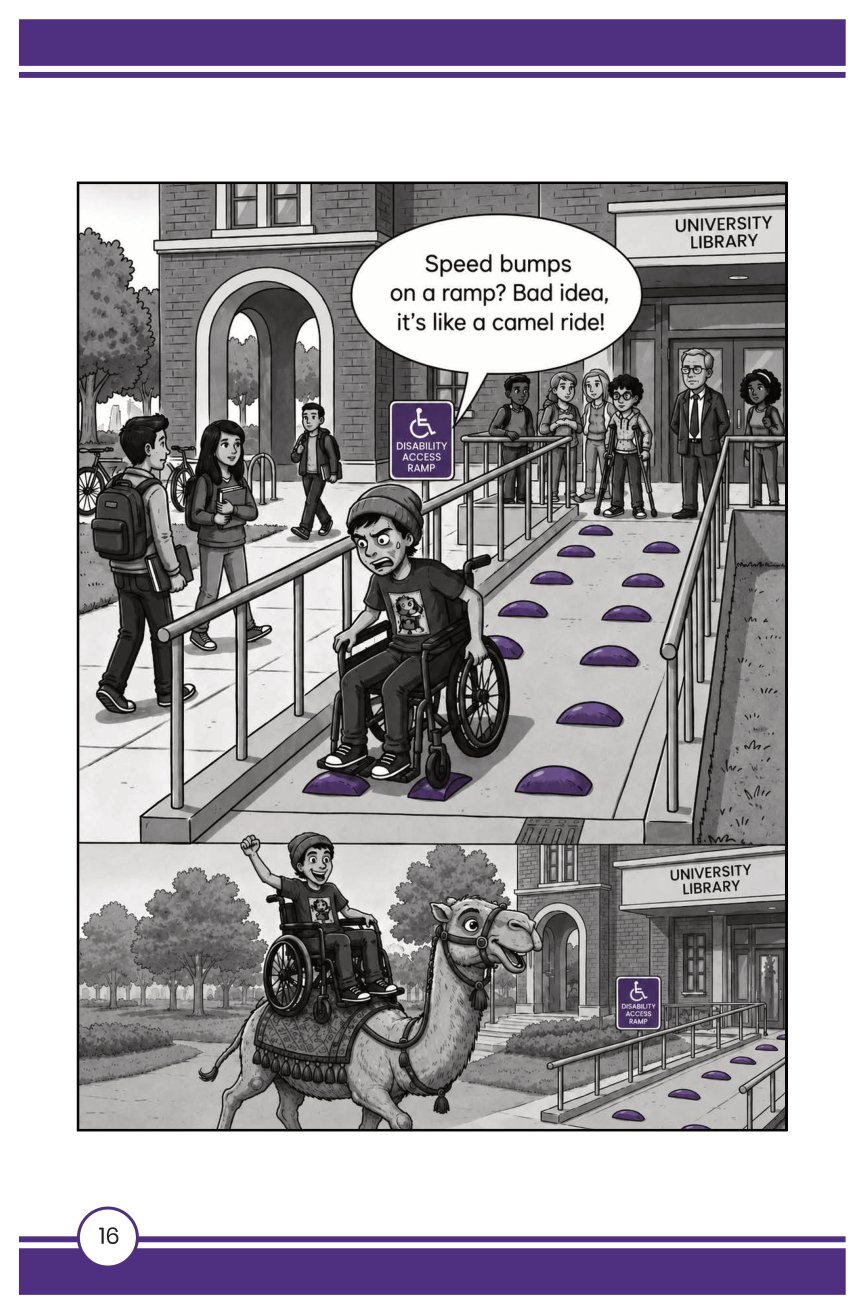
Beads of sweat fly off Sawaka’s face, as he mutters to himself, “Speed bumps on a ramp? Bad idea. It’s like a camel ride!” Sawaka, stressed and frustrated, is struggling in his wheelchair navigating many speed bumps on a ramp connecting the university library with the campus ground. Sawaka feels many eyes watching him — a man in a western suit and tie, flanked by five of Sawaka’s peers (students with backpacks) – they are all standing at the university library entrance end of the ramp.
Despite Sawaka’s wheelchair-user experience of the ramp, the university administration is clearly proud of the ramp. Beside the ramp, attached to a tall post is a large purple sign with the symbol for wheelchair access and text in white stating in upper case letters: DISABILITY ACCESS RAMP.
The next picture shows a triumphant, happy Sawaka in his wheelchair perched on the tassled rug-covered back of a smiling camel about to walk effortlessly up the ramp with multiple speed bumps.
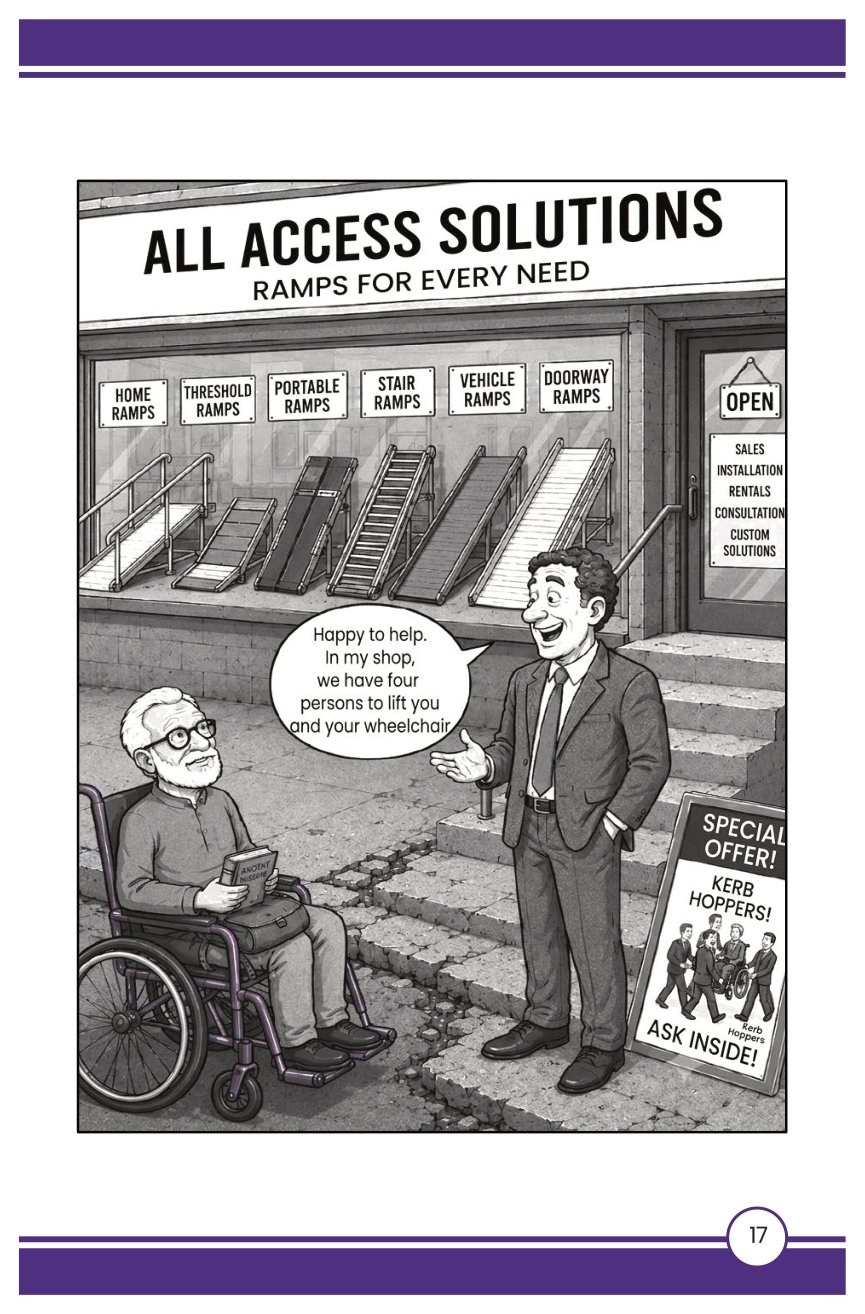
Dr. Chang Chim, a bespectacled, white-haired and white bearded wheelchair user, has a book resting on a bag on his lap. He looks up, bemused, at a man in a western suit and tie, oozing good cheer, while standing on the last of eight steps to the entrance of a store that sells, installs and rents “ramps for every need.”
The man, towering over Dr Chang Chim, smiles broadly at him, his left hand casually in his trouser pocket, his right hand outstretched toward Dr Chang Chim, palm open, “Happy to help. We have four men to lift you and your wheelchair.”
There is no sign of an apology for the inaccessible entrance to the store that profits from selling “custom solutions” for accessibility.
Above the window display is a massive storefront sign that boldly declares, “ALL ACCESS SOLUTIONS — RAMPS FOR EVERY NEED.” The large glass show window displays a row of six sample models labelled: Home Ramps, Threshold Ramps, Portable Ramps, Stair Ramps, Vehicle Ramps, and Doorway Ramps.
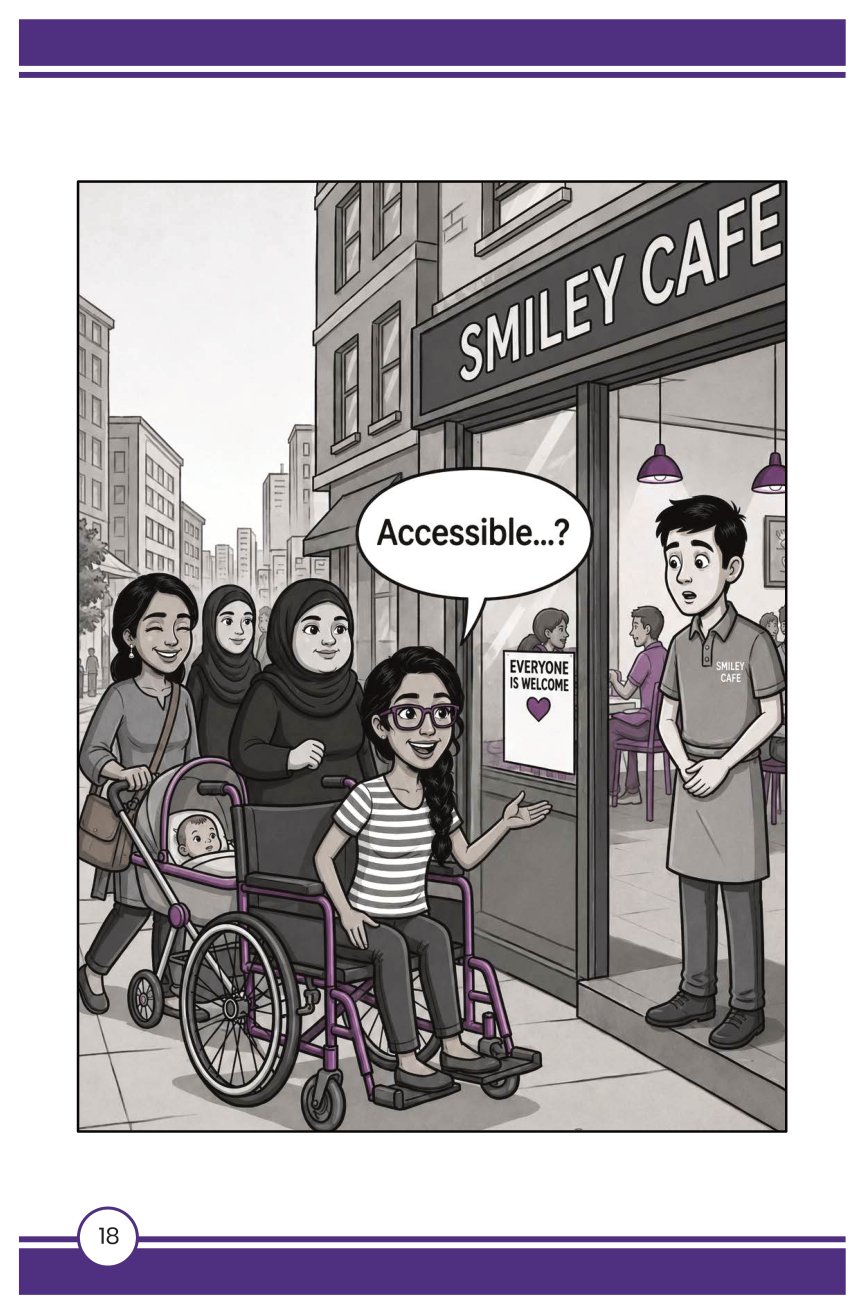
Puja, in a striped t-shirt and tight jeans, is using a wheelchair that cannot access the front entrance of the SMILEY CAFÉ. The café entrance has one step without ramped access. To Puja as a wheelchair user, crossing that one step is no different from her having to climb Mt Everest: both are not accessible.
Right behind Puja is a young mother, eyes closed and smiling blissfully while pushing a pram with a baby in it. With the young mother and behind Puja are two women wearing dark flowing robes and hijab. The café’s glass window has a sign: “EVERYONE IS WELCOME” with a heart under this message.
A young male waiter, standing at the entrance in front of Puja in her wheelchair, is at a loss as to how to respond to Puja’s smiling query, “Accessible …?” — her outstretched left hand, with its palm open, gestures to the café entrance with its barrier: one step.
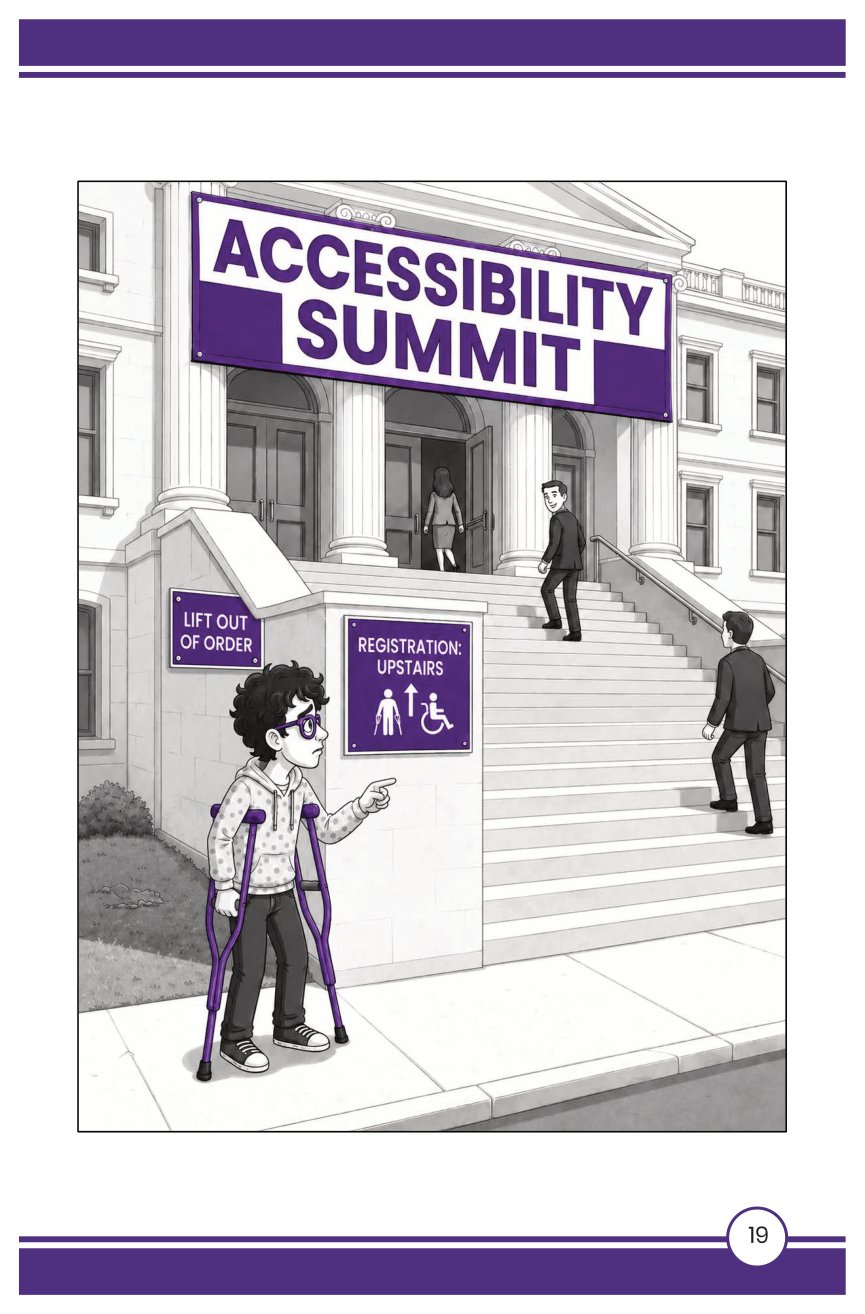
The access lift is out of order.
Ipul, double crutch user, is horrified at the steep, seemingly endless steps — it is like asking Ipul to scale up a steep mountain to reach its summit – in order to complete a vital, time-bound administrative task that will impact his future.
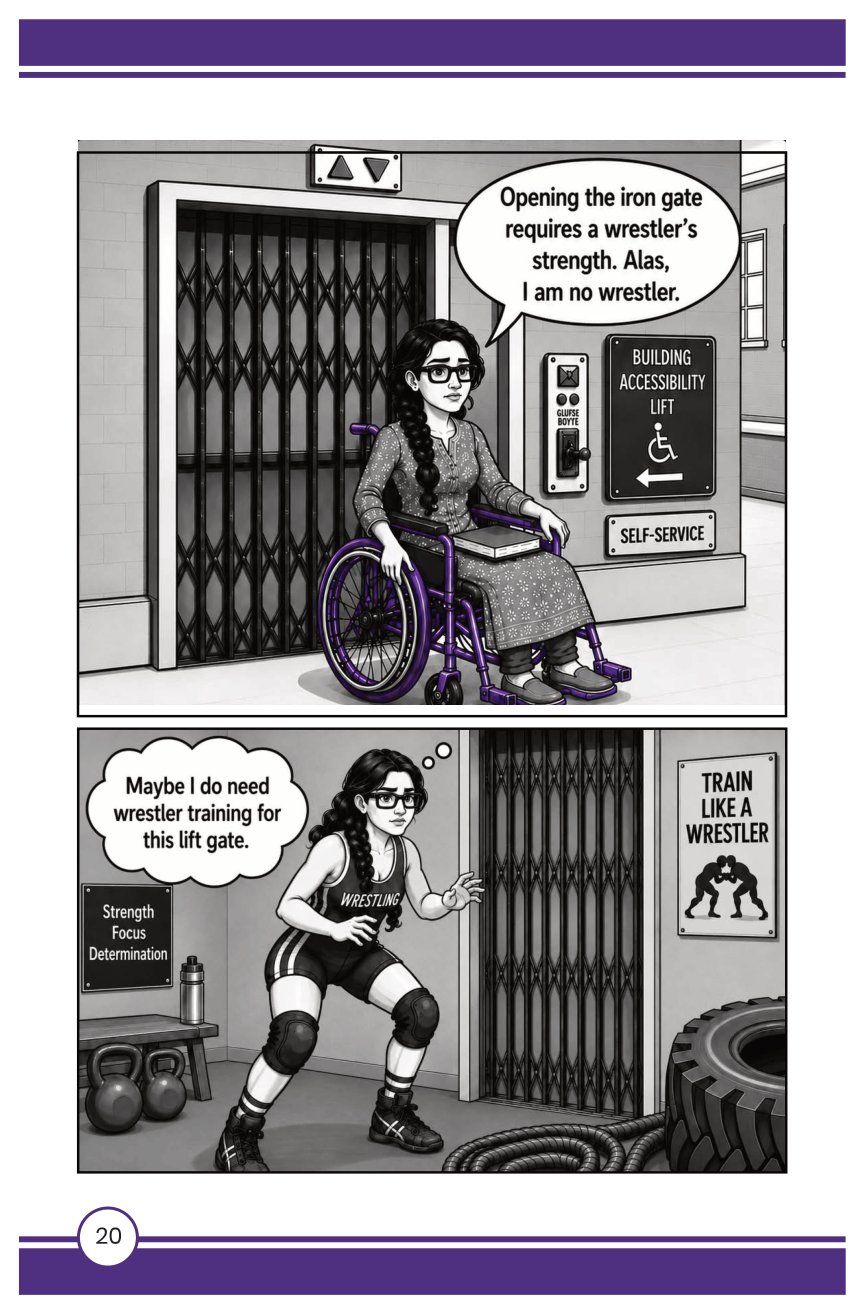
Puja, in her wheelchair, wants to enter a building that has a lift for accessibility. However, there is an iron accordion gate to be opened, in order to enter that lift.
On the wall beside the iron gate is a big sign indicating the availability of a lift for building accessibility. Below that is a much smaller sign stating “SELF-SERVICE,” meaning there is no lift operator to open the gate. Frowning, Puja thinks, “Opening the iron gate requires a wrestler’s strength. Alas, I am no wrestler.”
The picture below, shows Puja imagining herself embarking on wrestler training, and thinking, “Maybe I do need wrestler training to open this lift gate.”
Using the Space
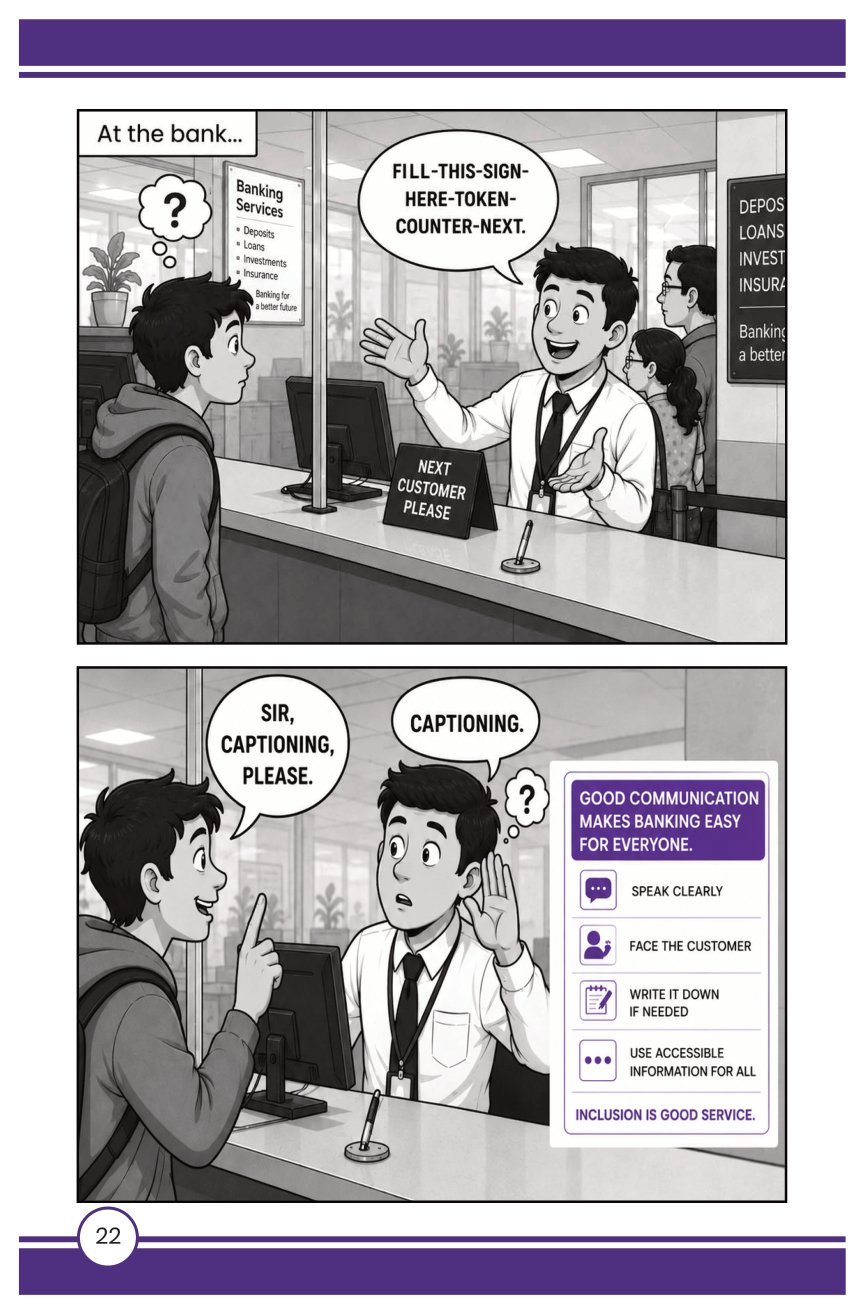
At the bank, Sawaka’s friend is confused by the rapid verbal instructions spilling out of the mouth of the bank officer: “Fill-this-sign-here-token-counter-next.”
Sawaka’s friend responds with a request to the bank officer, “Sir, captioning please.”
The bank officer, in turn, looks confused and asks, “Captioning?”
The inaccessible status quo is too often taken for granted as the necessary default setting.
In many branches of public service, a major challenge remains to be overcome — to enable clear communication that is accessible for all members of the general public: many communicate by using diverse formats and languages. And, not all at the same pace.
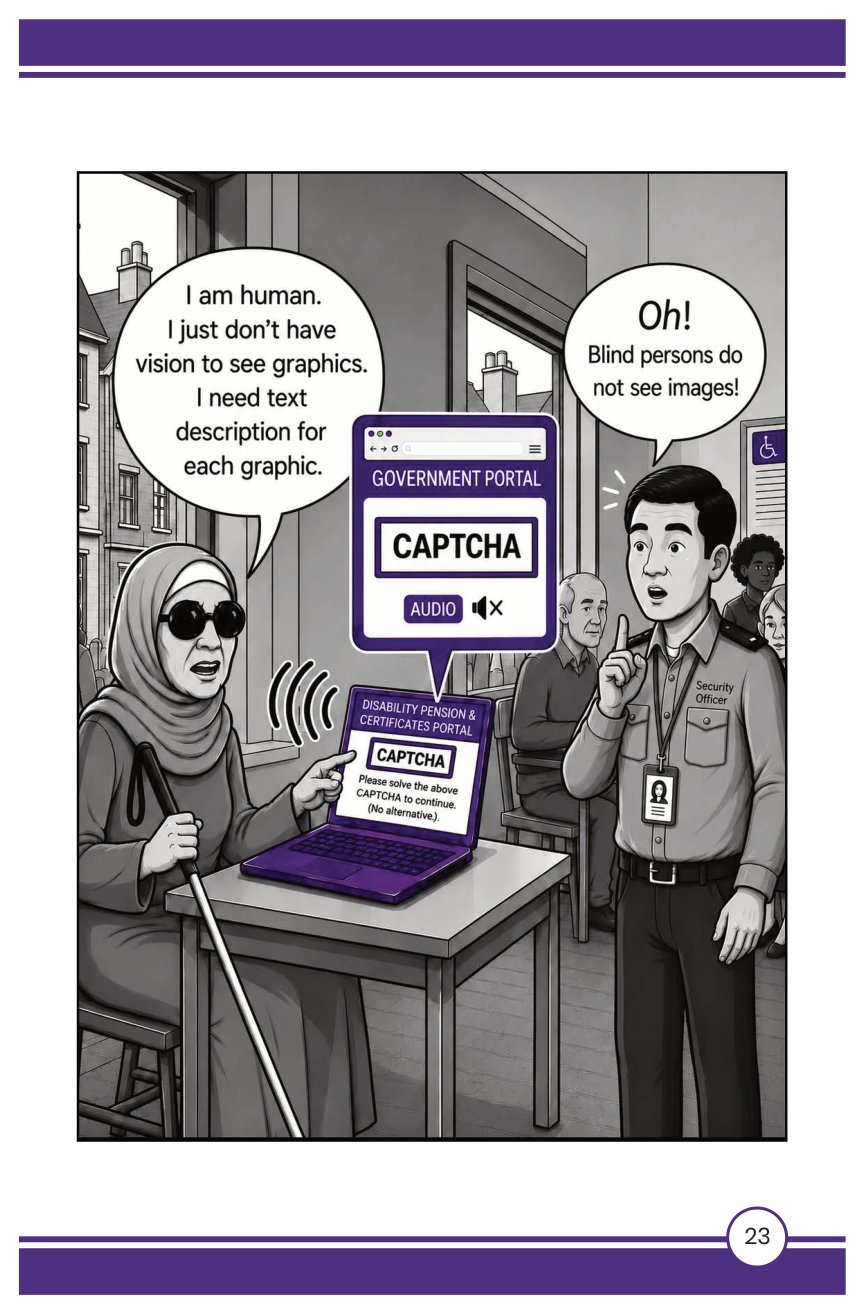
In a government office, Amina is sitting at a table with a laptop open before her. The screen shows a government portal for Disability Pension & Certificates. Below that is “CAPTCHA” with a requirement to solve the above CAPTCHA, thereby proving that a human (not a bot) wishes to continue.
However, there is no alternative to solving the visual CAPTCHA. Amina patiently explains to the Security Officer before her, “I am human. I just don’t have vision to see graphics. I need text description for each graphic.”
The Security Officer standing before Amina suddenly realises, “Oh! Blind persons do not see images!”
Ensuring access for persons with print disabilities on an equal basis with others — that has to be the new default setting for all e-government processes, apps, portals and platforms.
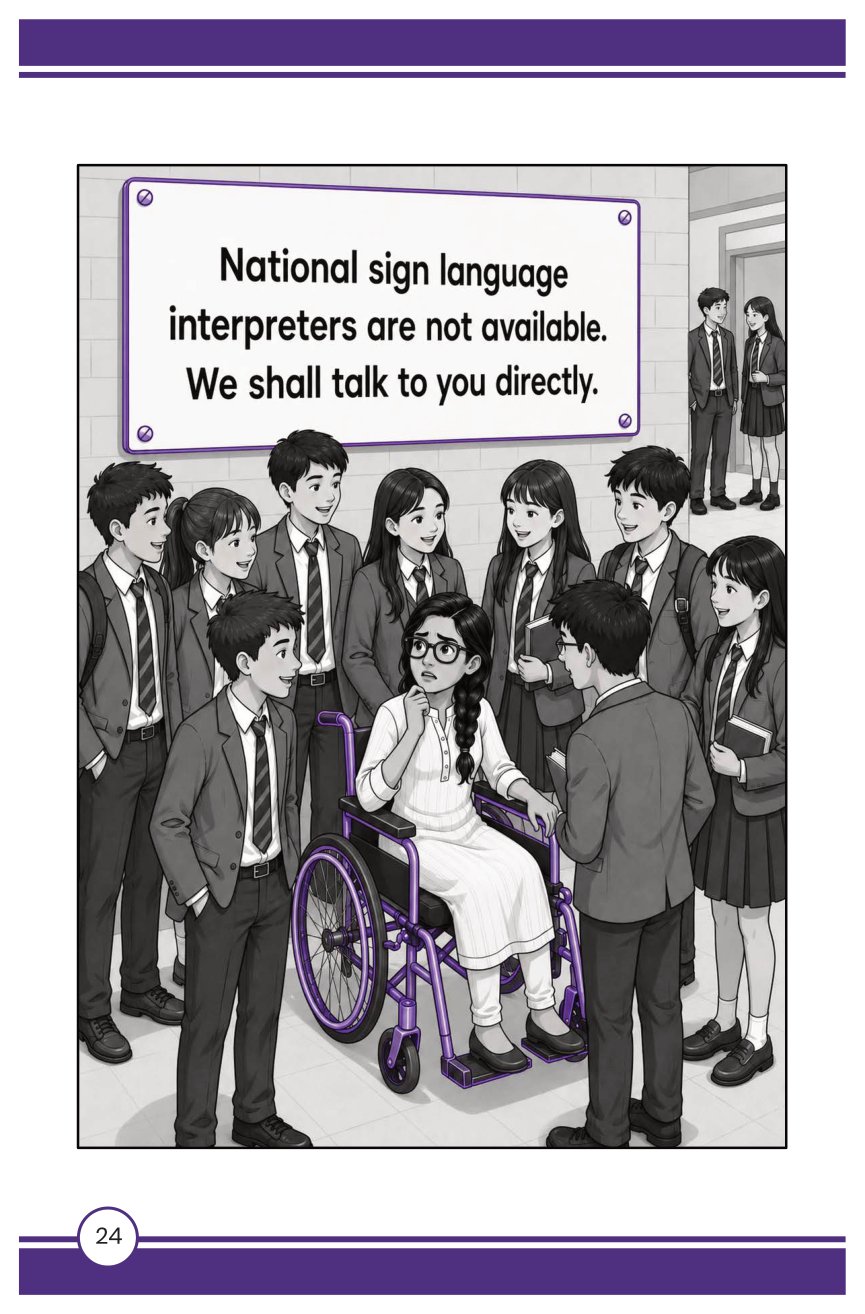
In an elite co-ed school hallway, nine students (four girls and five boys) in their teens, and wearing the western blazers and ties of their elite school uniform, stand around Puja in a semi-circle, relaxed and chatting among themselves. One boy student, wearing thin wire-framed glasses, a book in his left arm, is standing directly in front of Puja, but does not seem to be engaging directly with her. His peer, standing beside Puja’s wheelchair, has both hands in his trouser pockets and his attention is directed at the boy standing in front of Puja.
Bespectacled Puja, in a purple wheelchair, her thick, dark hair braided and wearing ethnic clothes (salwar, and buttoned-up, calf-length kameez), has turned to look at the boy student on her right, but is unable to follow what he is saying.
In her wheelchair, Puja is at a lower level than all these students. Her face wears an anxious expression.
On the wall behind the group of students encircling Puja is a very large information sign: “National sign language interpreters are not available. We shall talk to you directly.”
This situation shows the complex intersectionality of multiple divides and inequalities that compound the oppression and discrimination that Puja is facing.
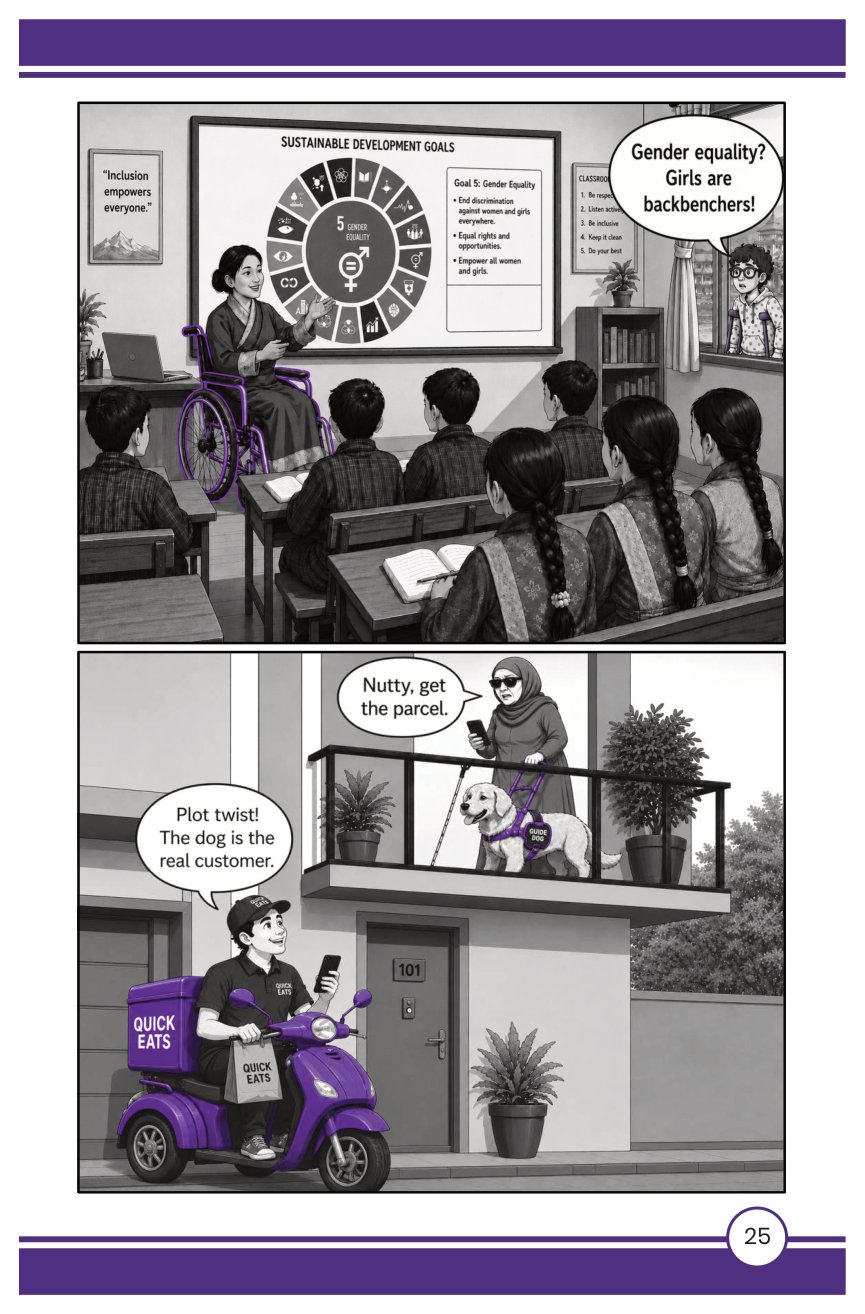
A woman teacher in an ethnic garment, hair neatly tied in a bun at the nape of her neck and using a wheelchair, has an open laptop on the table to her right. She is leading a lesson on the United Nations Sustainable Development Goals (SDGs), specifically SDG 5: Gender Equality. Her boy students are in the front row, while the girl students are in the back row. All are sitting attentively at their desks, focusing on the teacher and her presentation.
On the wall in front of the class and behind the teacher are three posters whose messages are: “Inclusion empowers everyone”; “Sustainable Development Goals, Goal 5: Gender Equality” (this is by far the biggest poster); and “Classroom Rules” (5 rules are listed).
Through an open classroom window, Ipul looks into the classroom and, in a speech bubble, voices his query, “Gender equality? Girls are backbenchers!”
On the balcony of her first-floor apartment, Amina stands with a smartphone in her right hand; her left hand holds the purple harness of her guide dog. The harness has a visible patch labelled “Guide Dog.” Through the glass panel on three sides of the balcony, Amina’s white cane can be seen propped against the glass panel.
Amina is instructing her dog, “Nutty, get the parcel.”
A delivery worker, wearing a short-sleeved shirt and a cap both labelled “Quick Eats,” is sitting on an electric three-wheeler scooter marked “Quick Eats.” The delivery worker is holding a smartphone in his left hand and a Quick Eats parcel in his right hand. A speech bubble from the delivery worker reads, “Plot twist! The dog is the real customer.”
This picture humourously portrays the independence of a Blind woman and her guide dog in an everyday activity. It highlights the role of assistive supports and accessible services in enabling persons with disabilities to manage important routine tasks such as ordering and receiving deliveries.
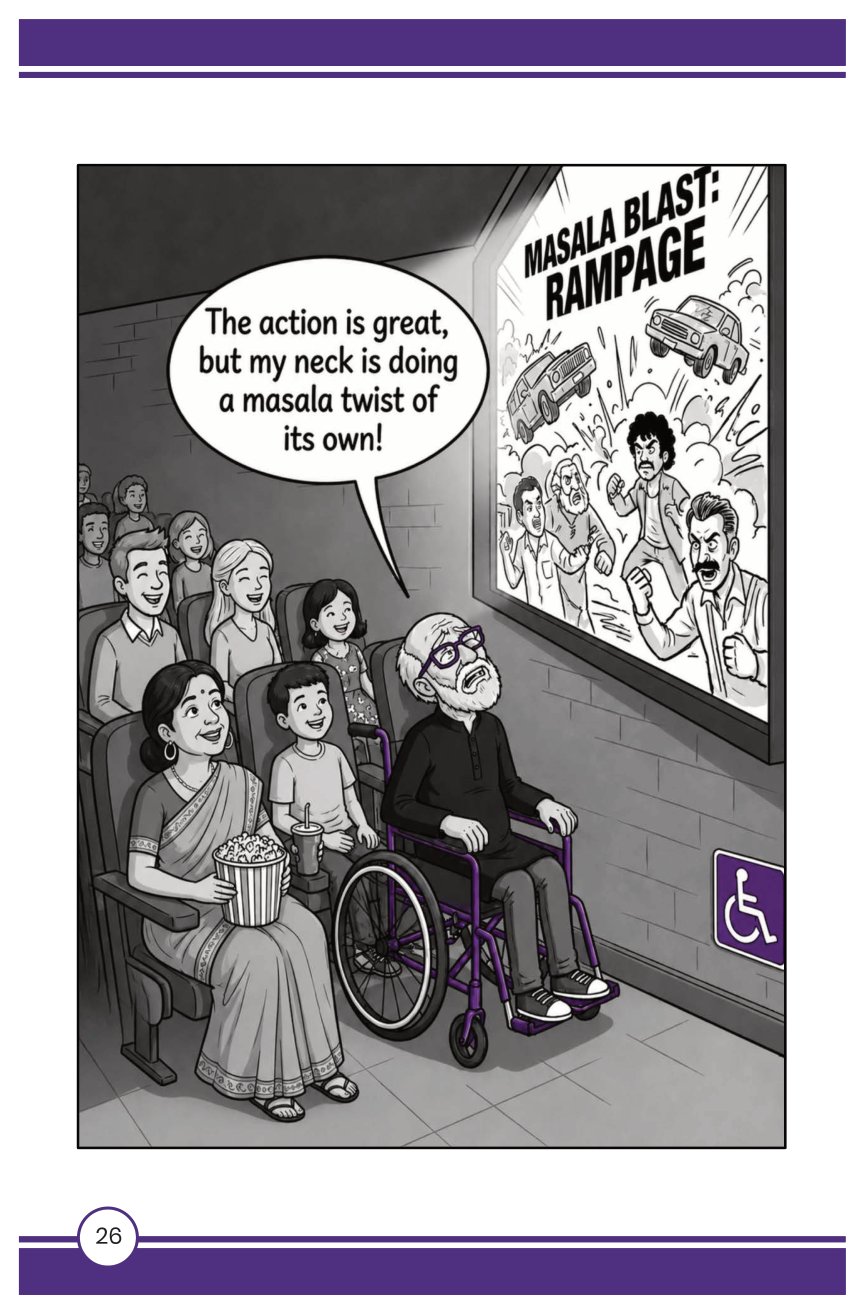
Masala Blast: Rampage.
In a packed cinema hall, Dr. Chang Chim, seated in his personal wheelchair, is in the space designated in that cinema for a wheelchair user: first row.
In that designated space, Dr. Chang Chim has to continuously hold his head high to view the screen. After a while, he says, “The action is great, but my neck is doing a masala twist of its own.” While the rest of the audience is enjoying the exciting film, he is bothered by his sore neck.
As a wheelchair user, Dr Chang Chim has a right to enjoy, on an equal basis with others, going to the cinema as a shared social experience. However, his experience was spoilt by the cinema management’s thoughtless choice of a space designated for a wheelchair user.
Prior consultation with wheelchair-user cinema goers regarding which space to allocate for an optimal viewing and social experience could have avoided such a problem from occurring.
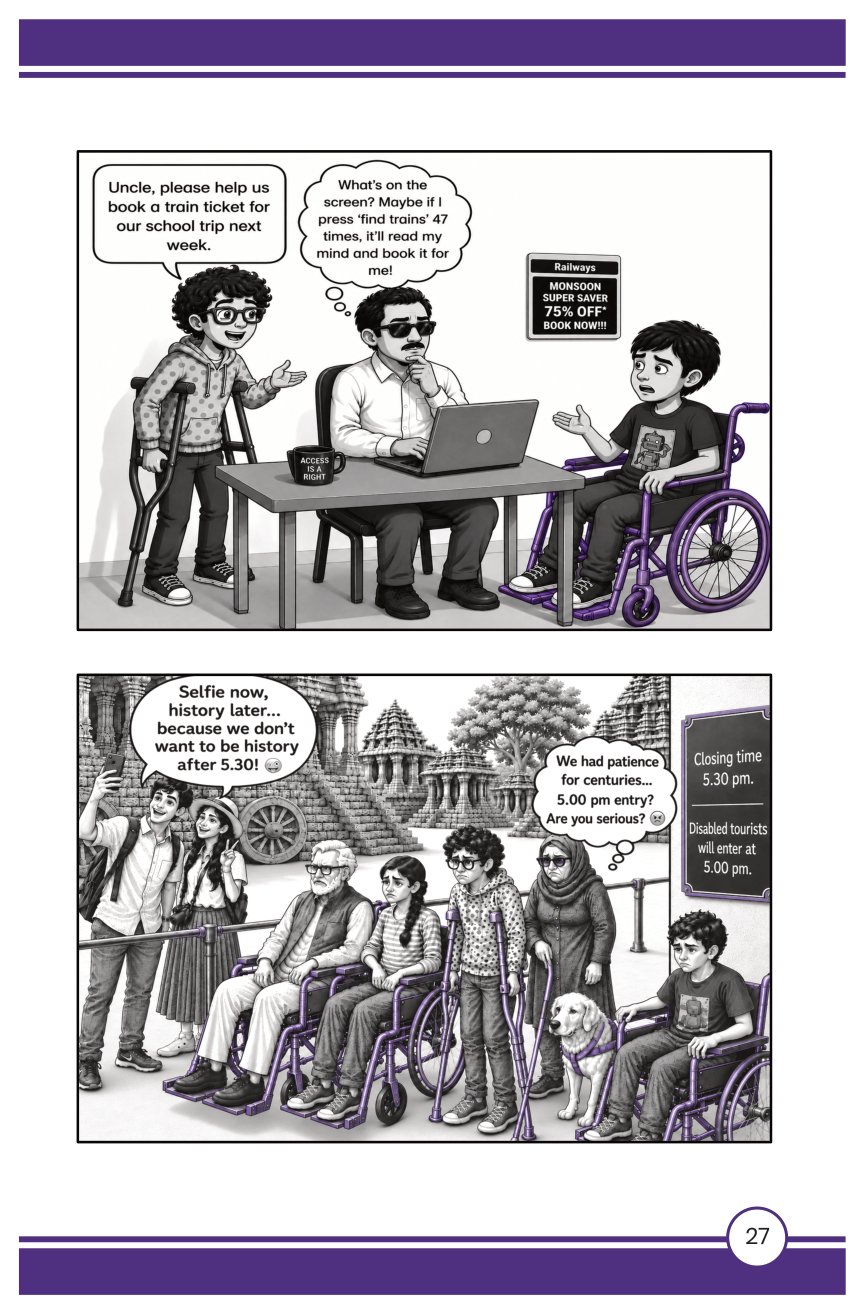
This illustration highlights digital accessibility challenges in online ticket booking. A Blind man, using a laptop, is trying to book train tickets on a railway website that is inaccessible for a screen reader user, making navigation impossible even with assistive technology. Behind the Blind man is an information board on a railway service special deal (MONSOON SUPER SAVER 75% OFF).
Standing to the right of the Blind man, Ipul pleads, “Uncle, please help us book a train ticket for our school trip next week.”
A thought bubble above the Blind man reads, “What’s on the screen? Maybe if I press ‘find trains’ 47 times, it’ll read my mind and book it for me!”
On his left, wheelchair user, Sawaka, looks exasperated while still hoping for a miracle to happen.
On the table is a mug; the message on it is: Access is a Right.
A scene at a heritage site — a sharp contrast between general tourist access (for non-disabled persons) and exclusion. A long metal bar, fixed to metal posts drilled into the ground, runs through the site entrance, segregating non-disabled tourists from tourists with disabilities.
Two young backpacker tourists, a young man holding up a phone and a young woman wearing a straw hat and light western clothes, are happily taking a selfie in front of the heritage site and telling themselves, “Selfie now, history later… because we don’t want to be history after 5.30.”
In the foreground, five frowning, unhappy persons with diverse disabilities wait near the entrance.
Behind them is an information board that states: “Closing time 5.30 pm. Disabled tourists will enter at 5.00 pm.”
Amina’s thought bubble reads, “We had patience for centuries … 5.00 pm entry? Are you serious?”
This picture shows a discriminatory access policy that unjustly and severely restricts the visiting time for persons with disabilities.
It highlights the need for adjustment to enable equal and inclusive access to cultural and heritage sites for all visitors.
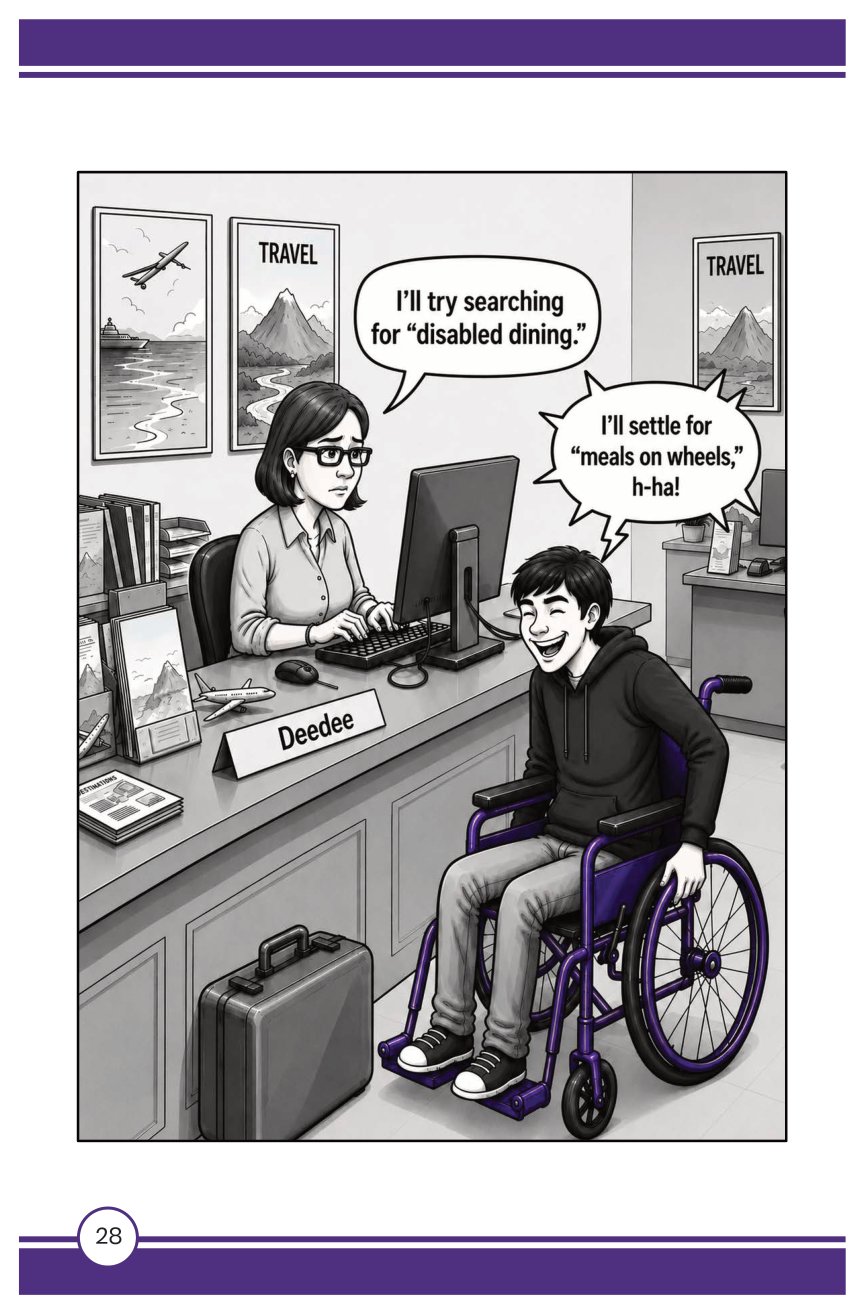
This is a light-hearted interaction in a travel agent’s office. A woman travel agent, Deedee, is trying to meet a request from wheelchair user, Sawaka.
Flustered, unsure of what to do but wanting to be helpful, she types on her computer, informing Sawaka, “I’ll try searching for ‘disabled dining.’”
Sawaka good-humouredly responds with, “I’ll settle for ‘meals on wheels,’ h-ha!”
The wall of the travel agent’s office displays two framed mountain landscapes labelled “TRAVEL” – they echo the ironic humour in Sawaka’s response to a mainstream travel agent’s inexperience and confusion in dealing with the right of a client to disability-inclusive and accessible tourism.
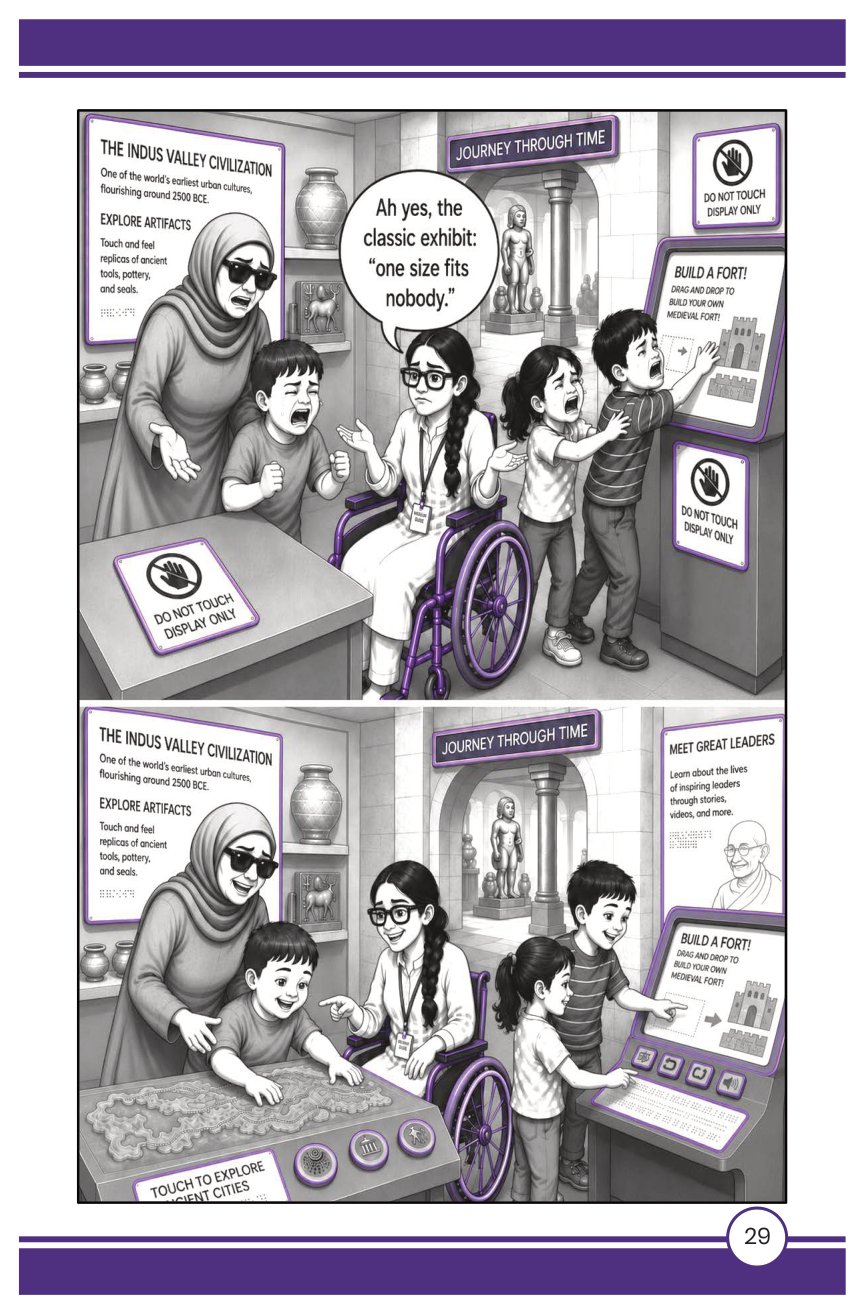
A two-panel illustration contrasts visitor experiences in a “before” and “after” museum gallery scenario: the first is a conventional “one size fits all” approach that limits viewing experience, leaving visitors dissatisfied.
In the “after” scenario, the exhibition was created according to universal design principles, enabling young and old to have a joyful experience, and even an interactive one with certain exhibits.
Top Panel – Inaccessible Exhibits: In a museum gallery on the Indus Valley Civilization, five visitors struggle to make sense of the Journey through Time exhibition. Amina is standing beside a crying child with Down’s syndrome near a display labelled “Do Not Touch – Display Only.”
Teacher Puja, wheelchair user, observes in frustration, “Ah yes, the classic exhibit: One Size Fits Nobody.” Nearby, another two crying children unsuccessfully try to interact with a touchscreen exhibit mounted at a height that they cannot easily reach. Multiple signs prohibit visitors from touching exhibits, leaving visitors unable to explore artifacts in meaningful ways.
Bottom Panel – Inclusive Exhibits: The same exhibition has been redesigned to be accessible and interactive.
Amina and a delighted child with Down’s syndrome together explore a tactile map labelled “Touch to Explore Ancient Cities” which has raised features and information in Braille. Teacher Puja comfortably participates.
Nearby, the two children are happily engrossed in an accessible interactive display; the touch screen and panel are positioned at a height that they can easily reach.
Braille labelling, tactile elements, audio and visual (including national sign language) description and inclusive digital exhibits enable visitors with disabilities to engage independently, creating an enriching museum experience for all visitors.
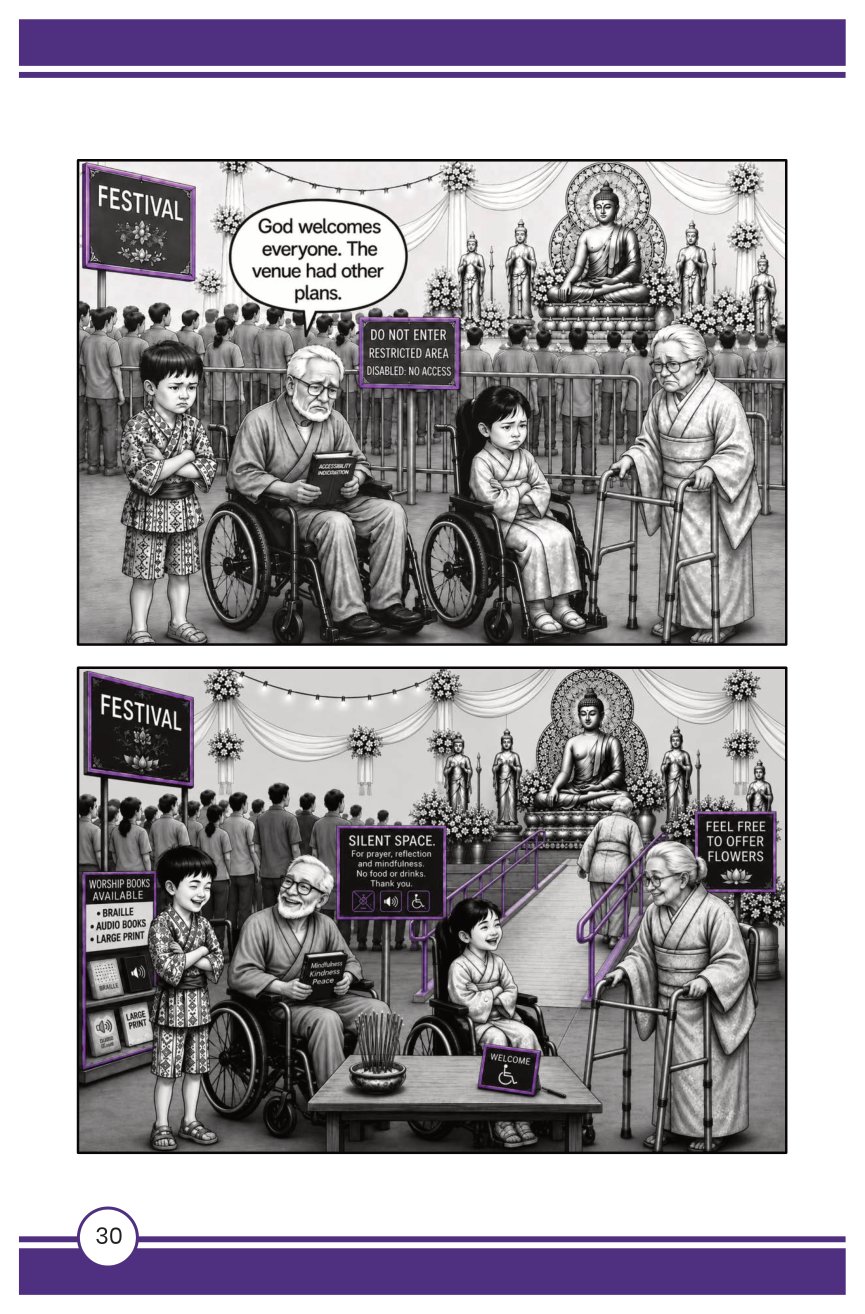
A two-panel illustration compares an inaccessible festival with an inclusive and accessible one.
Top Panel – Exclusion from a Festival: A large crowd gathers before a floral-decorated shrine featuring a larger, main statue sitting in lotus position, surrounded by four statues in standing position. In the foreground, four persons with disabilities are segregated from the main event by a sturdy metal barrier: Dr. Chang Chim and a young girl, both using wheelchairs, a boy standing with his arms folded across his chest, and an elderly woman using a walker — all look disappointed. They are excluded by unwelcoming signage: “DO NOT ENTER. RESTRICTED AREA. DISABLED: NO ACCESS.”
Dr Chang Chim observes, “God welcomes everyone. The venue had other plans.”
Bottom Panel – Inclusive Festival: The same festival is redesigned with accessibility features that enable everyone to participate. A gently sloping ramp with handrails provides access to the shrine area. There are wheelchair-accessible spaces. Tactile and interactive experiences are encouraged through a “Feel Free to Offer Flowers” area. Information is provided in multiple accessible formats, including Braille, audio books, and large print.
A “SILENT SPACE” sign for prayer, reflection and mindfulness and where food and drink are not allowed, indicates the availability of a sensory-friendly area for visitors, including neurodivergent persons. Dr. Chang Chim and a little girl, both using wheelchairs, a boy who has his arms folded across his chest, and an elderly woman — all look happy and engaged. The little girl’s feet, in white sandals, are visible under a table. On the table are two items: a round pot crowded with tall, lit incense sticks and a rectangular, purple picture frame. Inside the frame is “Welcome” and the symbol for wheelchair access in white on a black background.
This picture shows that inclusive design, particularly co-design with persons with disabilities, enables persons with disabilities and older persons to participate fully, independently, and with dignity in community festival celebrations.
Right to Pee
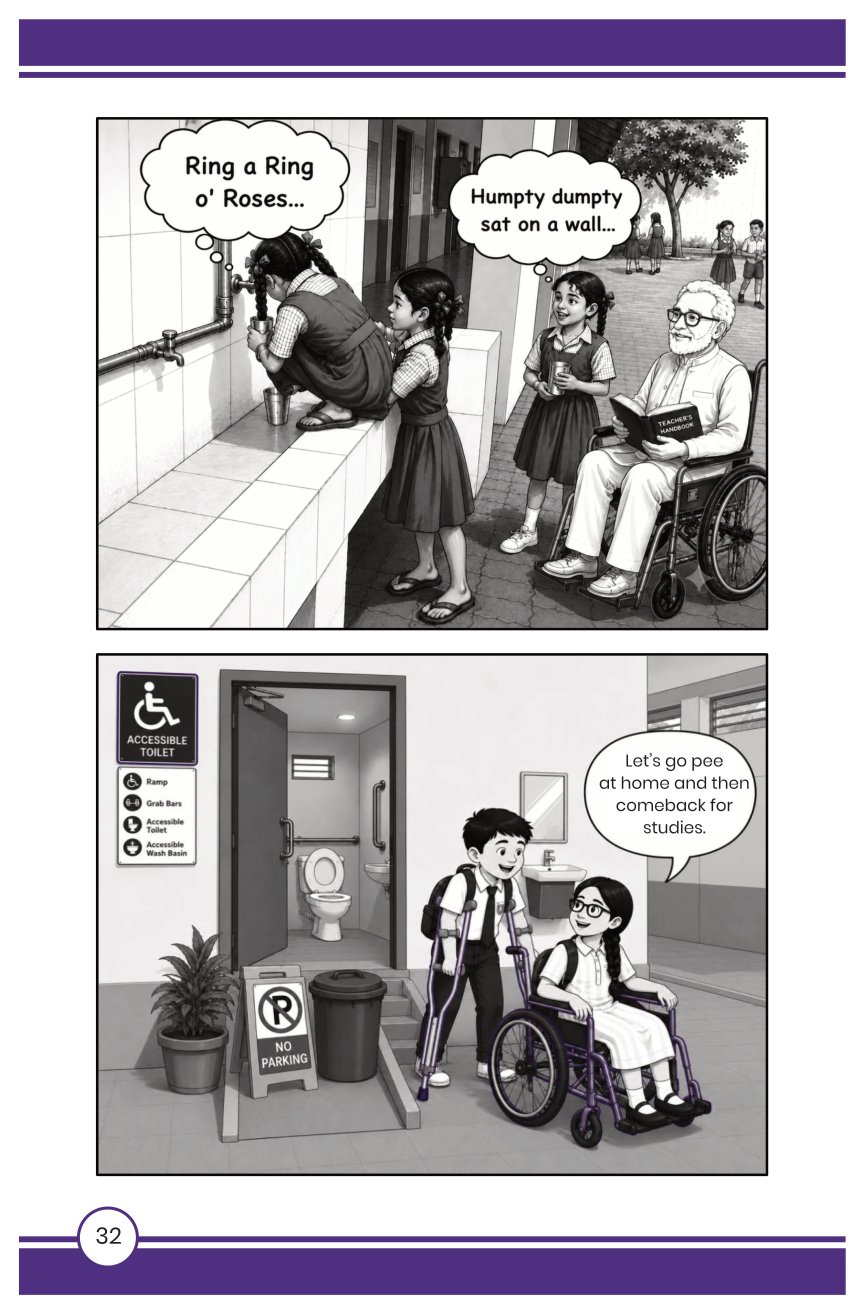
In a school courtyard, three young schoolgirls are at a drinking-water tap mounted on the wall of a raised white tiled sink.
A little girl crouches on the raised tile edge of the sink. The edge width is about the length of her sandalled feet. She is leaning forward to reach the tap while holding a shiny steel tumbler in her left hand. Her left braid of thick black hair has fallen into the tumbler, as she recites “Ring a Ring o’ Roses ….” Another little girl is beside her, awaiting her turn at the tap.
Dr. Chang Chim, using a wheelchair, looks up from the “Teacher’s Handbook” that he is reading to observe the two little girls at the water tap. A third girl stands behind them and on the right of Dr Chang Chim. Holding a tumbler in her hands while looking at the girl perched on the tiled edge of the sink, she is smiling and reciting a rhyme that she just learned, “Humpty Dumpty sat on a wall ….”
In the distance, away from this group at the school drinking water facility, there is a tall tree and a school food garden. Four children (three girls and a boy), in two pairs, are deep in conversation.
This picture shows an important school drinking-water facility that is inaccessible and potentially dangerous – it requires small children to climb onto a slippery, tiled edge along a sink, to access the water tap.
A toilet with its door open has signage beside the door. The signage prominently displays the symbol for wheelchair access, with large text stating “ACCESSIBLE TOILET.”
Under that, it lists four features with an image for each: ramp, grab bars, accessible toilet, accessible wash basin. Inside the toilet, grab bars are installed behind the toilet seat and between the toilet seat and the wash basin. A steep ramp leads to the toilet entrance. There are no railings on both sides of the steep ramp. On the ramp are a large, covered garbage bin and a “No Parking” sign, obstructing the use of the ramp.
In the foreground, a double crutch-user schoolboy stands behind a younger Puja who is using a wheelchair. Both are wearing school uniforms and carrying school backpacks. The boy smiles while Puja suggests, “Let’s go pee at home and then come back for our studies.”
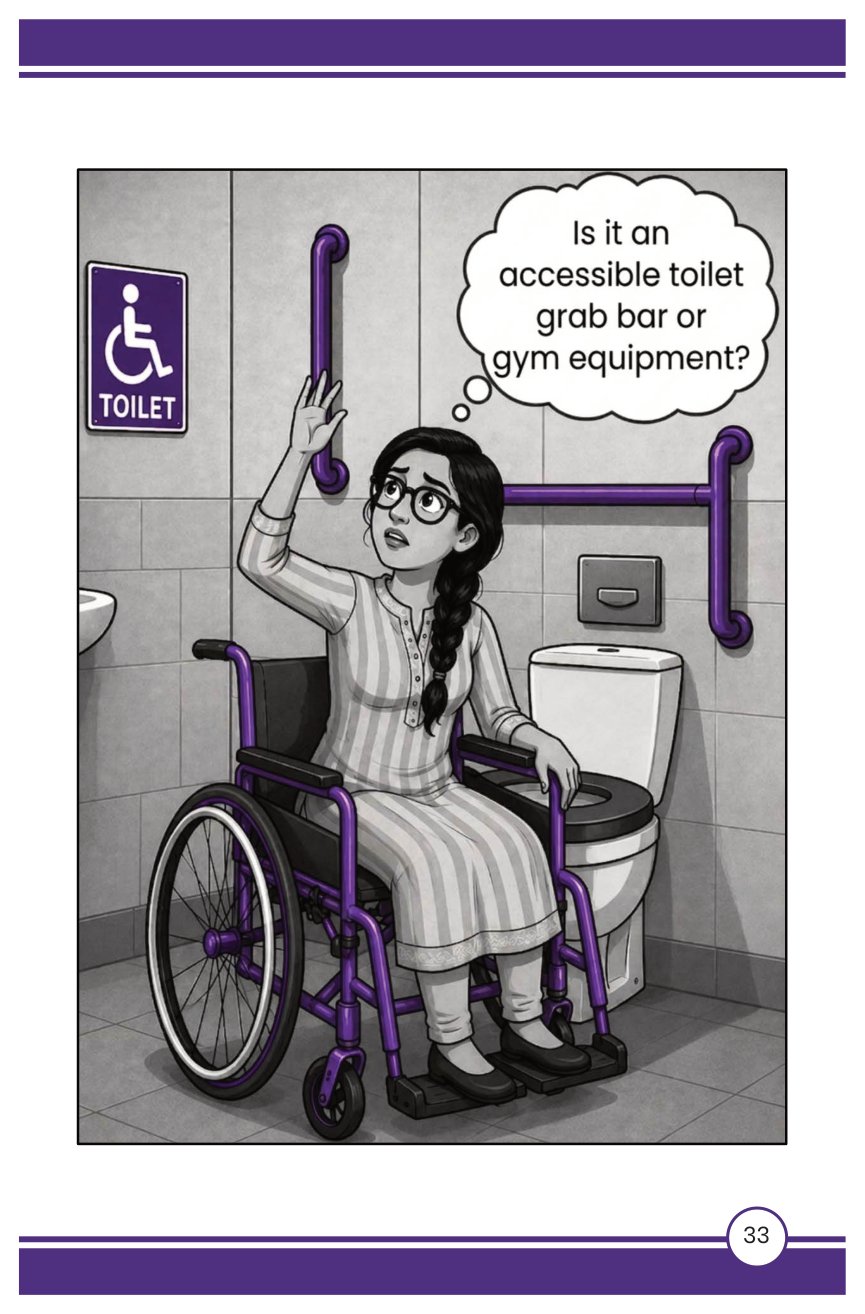
Bespectacled Puja, with her signature thick, long, dark braid, and wearing a long, striped kurta over churidars, is inside a toilet that pretends to be accessible. She is sitting in a wheelchair and is between a toilet bowl and a wash basin, without proper turning space.
Looking around her, Puja is confused. She strains dangerously to reach a grab bar mounted too high up on the tiled wall. Another grab bar is mounted incorrectly behind and to the side of the toilet. A thought bubble above her reads: “Is it a grab bar or a piece of gym equipment?”
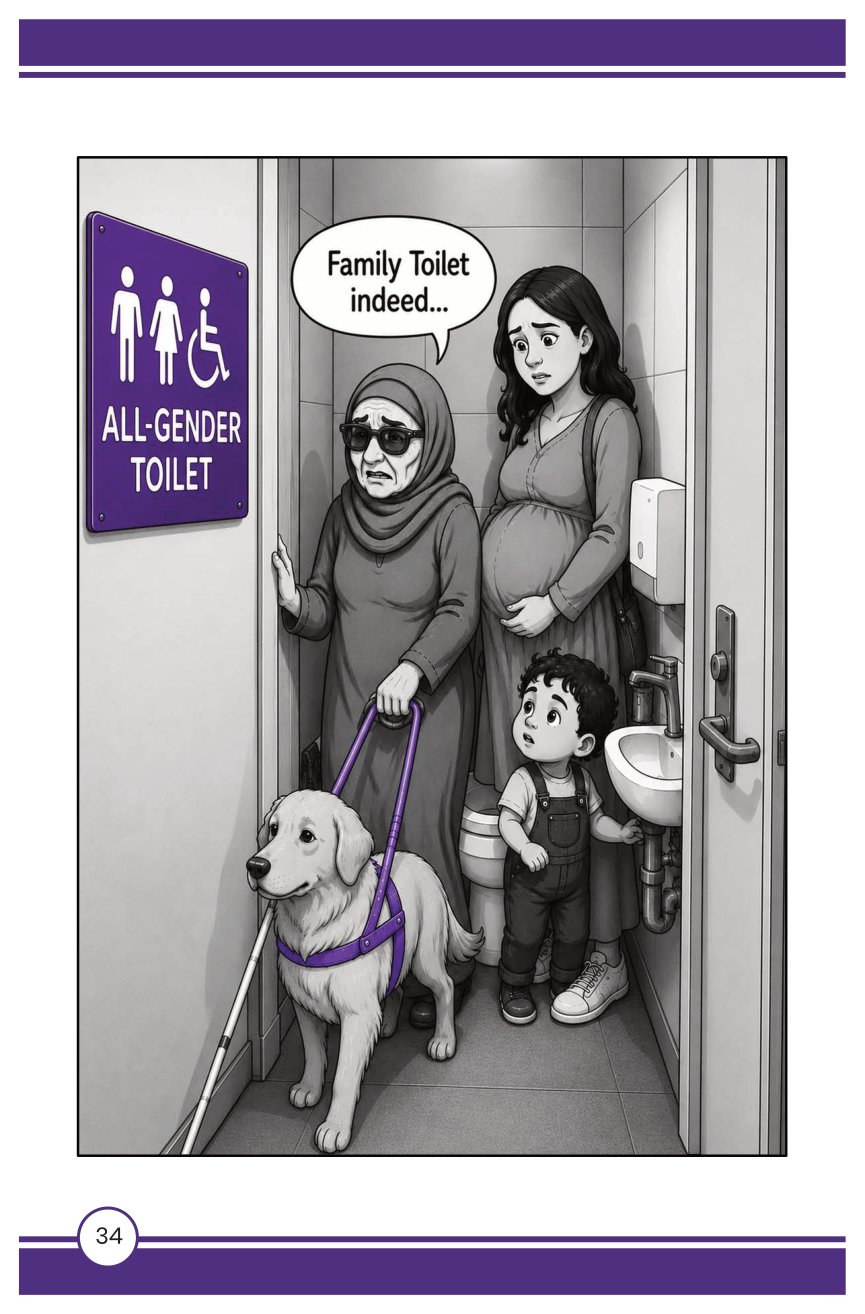
In an inadequately-sized, public restroom, Amina, an elderly blind woman wearing a hijab, burqa and dark glasses, has her right hand on the wall of the public rest room. She is holding in her left hand the harness of her guide dog, while her white cane has slipped out of her hand. With Amina and her dog are a heavily pregnant woman with a prosthetic leg and a toddler — squashed in, right against the toilet and a small sink. They are packed like sardines.
Outside this public restroom, there is a sign with the icons of a man, a woman, and a wheelchair user. The sign reads: “ALL-GENDER TOILET.”
Amina observes, “Family Toilet, indeed …”
Exiting the Space
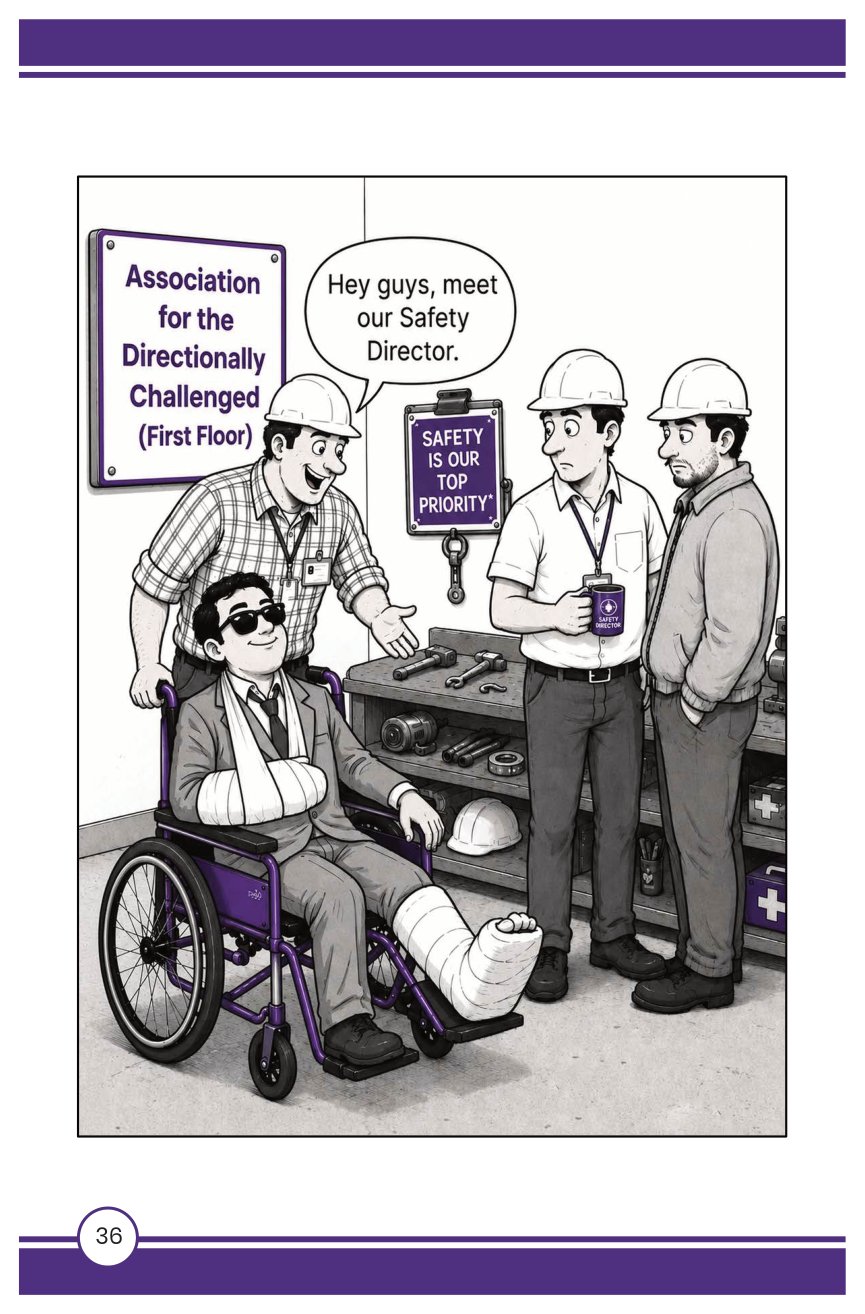
A satirical picture of a factory setting, with tools, first aid boxes and a hard hat on shelves. A smiling supervisor wearing a white hard hat pushes a smiling man in a wheelchair towards two astonished colleagues on a tea break.
The man in the wheelchair wears dark sunglasses, and a western suit and a tie whose knot is a bit loose. His right forearm is heavily bandaged and his right arm is in a sling. His left leg is stretched out in a stiff plaster cast. His injuries are recent.
On the wall above the shelves where special tools are kept after use, a purple sign with white text reads: “SAFETY IS OUR TOP PRIORITY.”
Contrast this with the cheerful supervisor’s speech bubble: “Hey guys, meet our Safety Director.” One of the colleagues holds a mug labelled “SAFETY DIRECTOR.”
In the top left corner of the picture, another sign reads: “ASSOCIATION FOR THE DIRECTIONALLY CHALLENGED (FIRST FLOOR).”
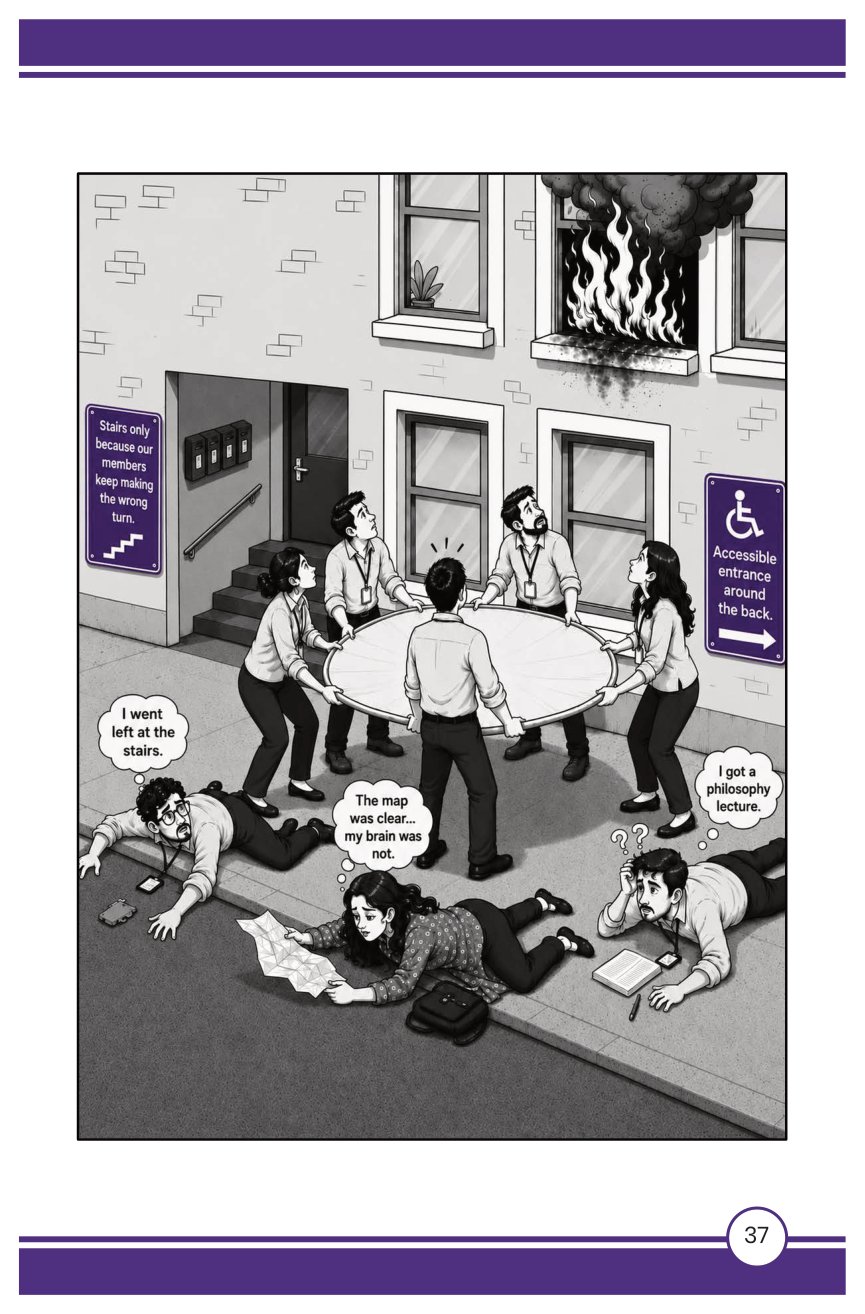
On the outside wall at the entrance into a building, there is a large purple sign with a message in white text: “Stairs only because our members keep making the wrong turn.”
Through an open second-storey window, thick smoke and a raging fire are visible. On the pavement below, a rescue team of five people are holding a large, circular safety net, waiting for someone to jump from the burning window.
In the foreground, three people (two men and a woman) are lying prone and exhausted on the pavement. From left to right: the first is a man who admits, “I went left at the stairs.” In the middle, a woman is holding a map, reflecting, “… the map was clear, my brain was not.” The third person, a man, is perplexed: “I got a philosophy lecture.”
On the building’s exterior wall under and somewhat to the right of the burning window, there is a dark purple wall sign. The sign has on it, in white, the symbol for wheelchair accessibility; beneath that is directional information and a thick white arrow pointing away from the entrance to the building: “Accessible entrance around the back.”
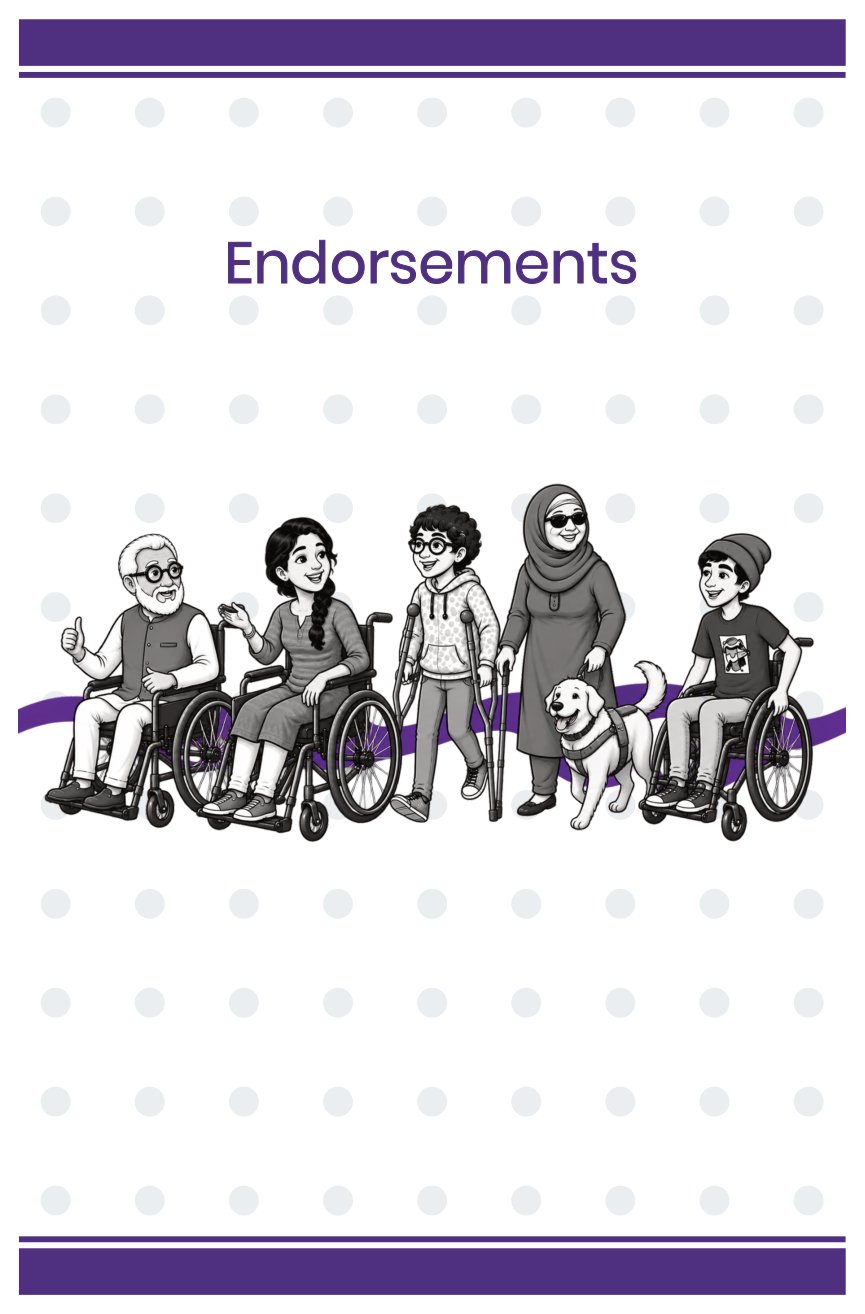
Lined up from left to right: Dr Chang Chim, Puja, Ipul, Amina and her guide dog, and Sawaka in his wheelchair.
Endorsements
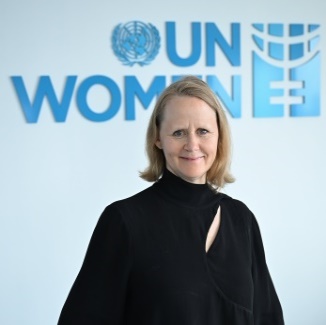
“Almost Accessible” is an excellent example of how storytelling can break down barriers that policy alone often cannot. Conceptualized, designed, and illustrated by women with disabilities, it shows what’s possible when women with disabilities lead the way. By reaching new and unexpected audiences, it responds to a real need for innovation and practical approaches in advancing the rights of women and girls with disabilities across Asia and the Pacific.
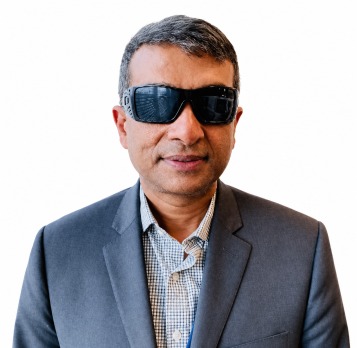
Building accessible communities begins with awareness and understanding. When we recognize the barriers that prevent children, youth, and adults with disabilities from fully participating in everyday life, we take the first step towards creating more inclusive and accessible communities for everyone. Through humour, storytelling, and real-life situations, “Almost Access!ble” invites us to do exactly that.
Every child has the right to survive, thrive, learn, play, communicate, and participate fully in family and community life. Yet millions of children with disabilities continue to face barriers that limit these opportunities. Creating accessible environments … is essential to realizing their rights and ensuring that every child has an equal opportunity to learn, participate, and thrive.
By engaging students, educators, planners, architects, engineers, service providers, policymakers, and communities, it reminds us that accessibility is everyone’s responsibility and an essential foundation for inclusive development.
I hope “Almost Access!ble” inspires readers of all ages to see the world through a different lens, challenge assumptions, and take action. Every barrier we remove opens the door to new opportunities. Every accessible school, website, health centre, playground and public space brings us closer to a world where every child, including every child with a disability, can participate, contribute and belong. Building a more inclusive world starts with each one of us — with me, with you, with all of us.
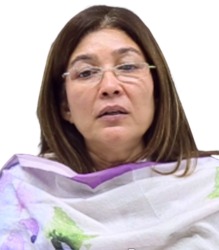
I warmly congratulate the Asia-Pacific Network for Accessibility (APNA) and all contributors on the publication of the remarkably creative comic book “Almost Access!ble.” Through humour, compelling visual storytelling, and relatable real-life scenarios, this unique publication transforms complex accessibility challenges into engaging and thought-provoking narratives that resonate with readers of all ages particularly young people, educators, policymakers, and decision-makers.
As disability rights activist Judith Heumann so memorably put it, ‘Disability only becomes a tragedy when society fails to provide the things we need to lead our lives.’ Almost Access!ble embodies this truth: rooted in the principles of universal learning and inclusive education, the comic powerfully highlights how physical, digital, communication, and attitudinal barriers not disability itself continue to limit equal participation in everyday life.
Its use of graphic storytelling is especially valuable: by making accessibility tangible and personal rather than abstract or technical, the comic reaches audiences that policy documents and reports often fail to move, and plants the seeds of empathy and awareness early, particularly among students and young readers.
Importantly, it inspires action towards creating inclusive schools and universities, accessible cultural sites, museums, monuments, and public spaces, ensuring that everyone can learn, explore, participate, and contribute with dignity.
This publication also echoes the guiding spirit of the disability rights movement, captured in the enduring call: ‘Nothing about us, without us.’ It is a reminder that accessibility is not a favour extended to persons with disabilities but a shared right and a collective responsibility, one that benefits older persons, families with young children, and indeed entire communities when truly embraced.
This publication is a timely and meaningful contribution to the region’s efforts to fulfil the commitments of the Incheon Strategy and the broader vision of the 2030 Agenda for Sustainable Development, leaving no one behind.
I hope this innovative publication will motivate individuals, institutions, and governments across the Asia-Pacific region to reimagine accessibility not as a compliance requirement, but as an opportunity to build a more inclusive, equitable, and barrier-free society for all. I also hope it finds its way into classrooms, libraries, and training programmes throughout the region, so that its message reaches as wide an audience as possible.
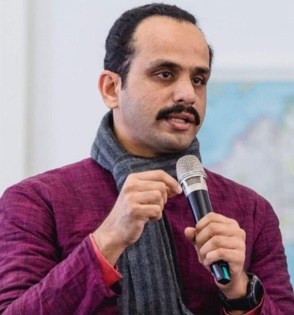
I am delighted to learn about “Almost Access!ble” and the idea to use humour and everyday situations to unpack barriers faced by persons with diverse disabilities, especially girls and women with disabilities. The fact that the comic book has been conceptualized and created by women with disabilities themselves makes it a particularly powerful example of meaningful participation and leadership in advancing accessibility and inclusion across the Asia-Pacific region.
The focus on translating technical accessibility concepts into engaging, practical storytelling for young people, service providers, planners and decision-makers is very timely, and resonates strongly with WHO’s commitment to disability inclusion, universal access and leaving no one behind. I also appreciate APNA’s efforts to prepare accessible formats, which will help ensure that the comic book reaches a wide and diverse audience.
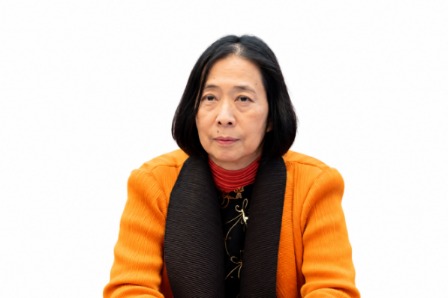
“Almost Access!ble” is a powerful reminder that accessibility is fundamental to the realization of human rights, dignity and sustainable development. By placing the leadership, lived experiences and creativity of women with disabilities at the heart of its storytelling, this publication affirms that inclusive societies are built through meaningful participation, universal design and collaboration from the outset. It is a timely and inspiring contribution to advancing our shared commitment to ensure that no one is left behind.
I love this comic book so much. It is easy to understand when we read it … and encourages readers to understand how to make our society and communities inclusive, for harmonious living together.
First of all, I would like to express my deepest appreciation to Asia-Pacific Network for Accessibility for publishing this remarkable book. Although presented as a picture book, it is by no means intended only for children. Rather, it is a book that every adult—especially those who have long understood disability as an individual problem, i.e. from the scope of the individual model of disability, should read.
Through vivid and accessible examples, this book clearly illustrates that the challenges experienced by persons with disabilities are not the inevitable result of their impairments, but are human rights issues created by discrimination and exclusion within society. As readers turn each page, they come to understand that disability is not simply a personal condition but a form of socially constructed discrimination. The social model of disability emerges not as an abstract concept, but as a living reality.
Twenty years after the adoption of the United Nations Convention on the Rights of Persons with Disabilities, it is difficult to say that the social model of disability has become the dominant perspective in society… That is precisely why this book is so important. It has the power to challenge our assumptions, deepen our understanding of disability as a matter of human rights, and inspire each of us to help build a society in which everyone can live with dignity and equality.
A page of seven organisational logos: Swavlamban, Accessible India Campaign, ESCAP, WHO India, APCD, Make the Right Real in Malaysia (The OKU Rights Matter Project), and DET Forum.
Review & Editorial Team
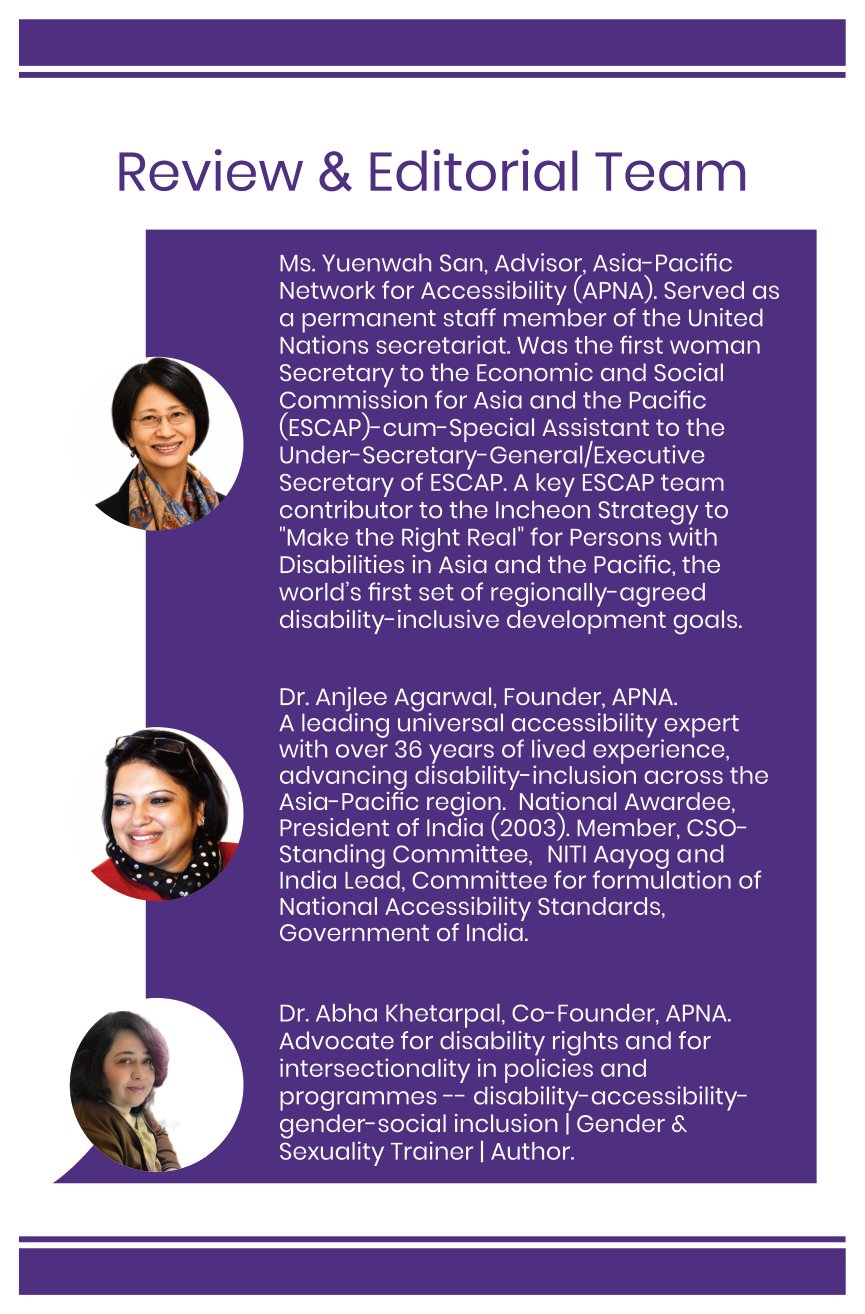
Portraits and titles of Review & Editorial Team members: Ms. Yuenwah San, Dr. Anjlee Agarwal, and Dr. Abha Khetarpal.
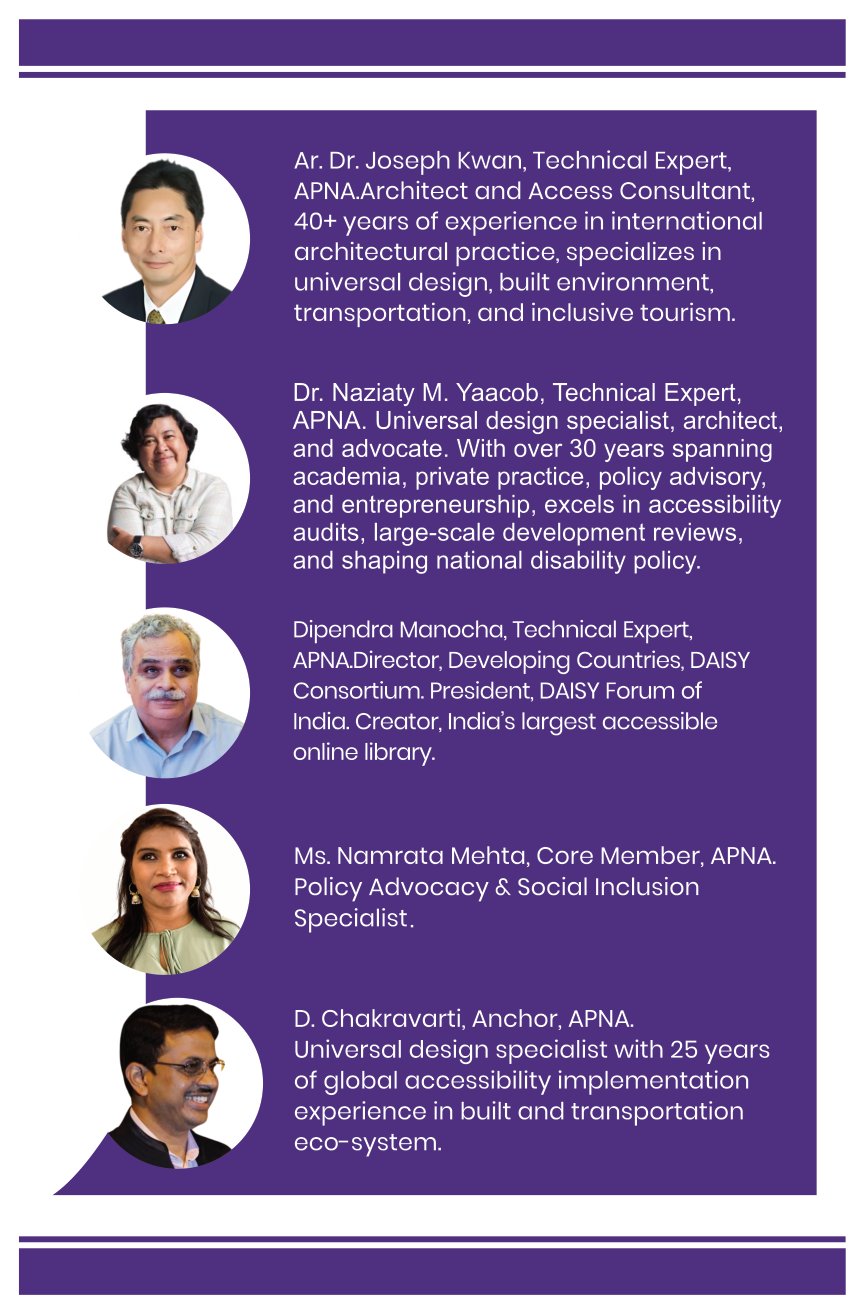
Portraits and titles of Review & Editorial Team members (continued): Ar. Dr. Joseph Kwan, Dr. Naziaty M. Yaacob, Dipendra Manocha, Ms. Namrata Mehta, and D. Chakravarti.
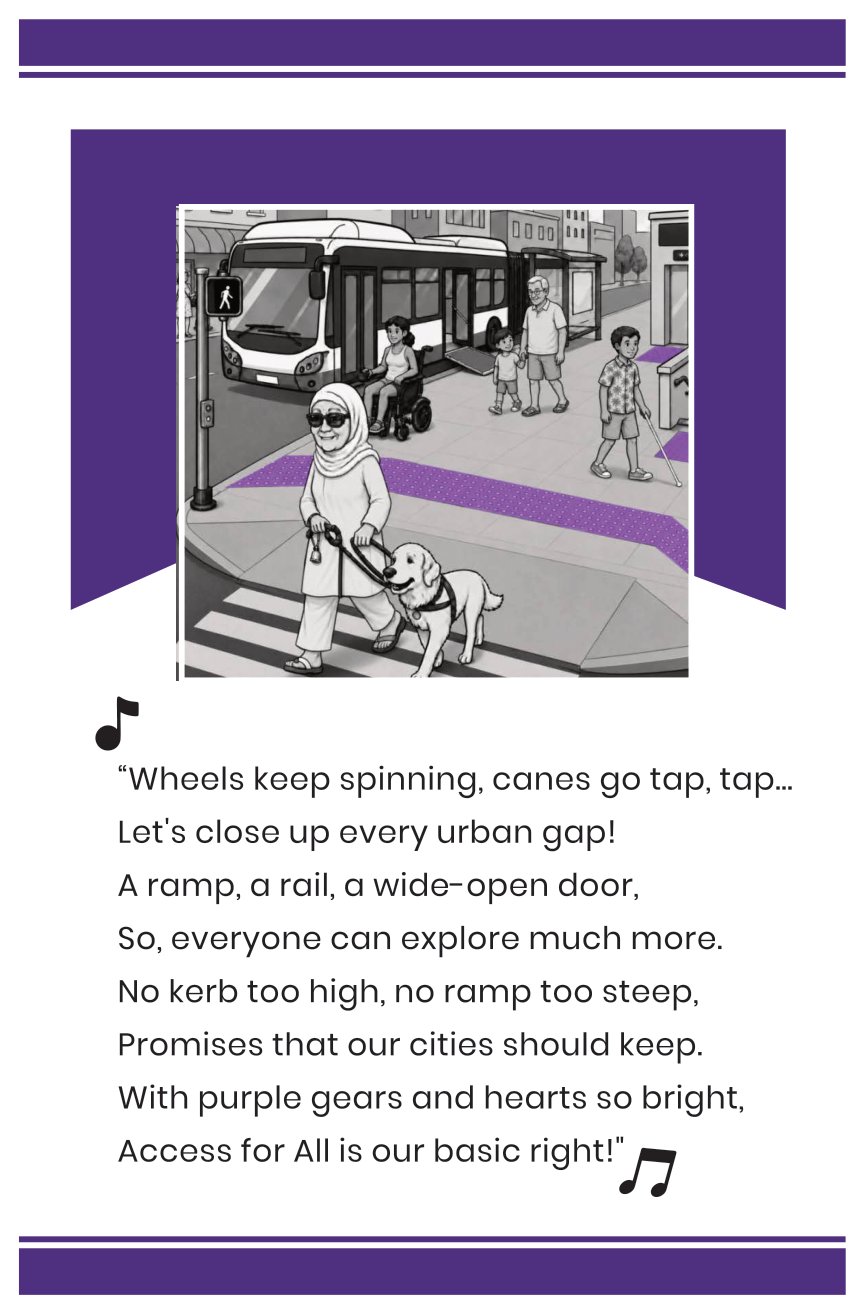
On a hot day, a universally-accessible urban street scene: a low-floor public bus is parked at a level boarding station with its ramp deployed, enabling a young wheelchair user woman in a tank top and shorts to exit smoothly.
Nearby, an elderly man walks with a small child. An older boy, in a short-sleeved shirt and shorts and wearing canvas sneakers, is using a white cane in his left hand to find his way on the pavement. He has not yet reached the tactile blocks that form a pathway on the pavement from one kerb stretching up a gentle slope across the pavement and down a gentle slope towards another kerb. There is also a gentle kerb ramp for wheelchair users.
In the foreground, an elderly blind woman wearing sunglasses, a white hijab over a white, long-sleeved top and white long pants, is using a zebra crossing safely, accompanied by her guide dog whose harness she is holding with both hands.
Below the illustration, flanked by music notes, the text reads:
“Wheels keep spinning, canes go tap, tap
Let’s close up every urban gap!
A ramp, a rail, a wide-open door,
So, everyone can explore much more.
No kerb too high, no ramp too steep,
Promises that our cities should keep.
With purple gears and hearts so bright,
Access for All is our basic right!”
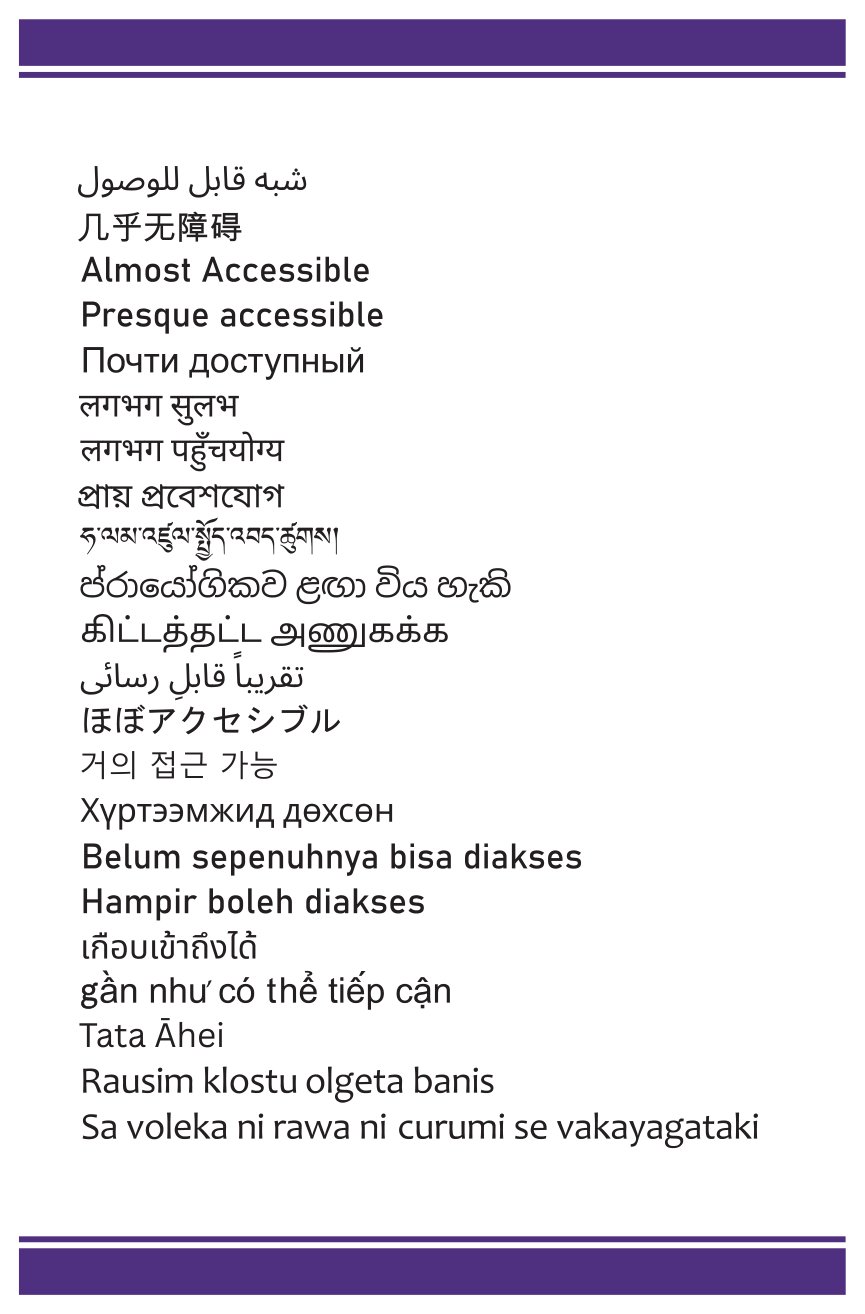
APNA Comic Book. “Almost Accessible” is the title of this comic book. This page shows the title translated into a sample of the many languages used in Asia-Pacific: English, Chinese, Russian, Arabic; Hindi, Bengali, Dzongkha, Nepali, Sinhala, Tamil, Urdu; Japanese, Korean, Mongolian; Bahasa Indonesia, Bahasa Malaysia, Thai and Vietnamese; te reo Māori (official language of New Zealand), Tok pisin (national lingua franca of Papua New Guinea) and iTaukei (Indigenous language of Fiji).
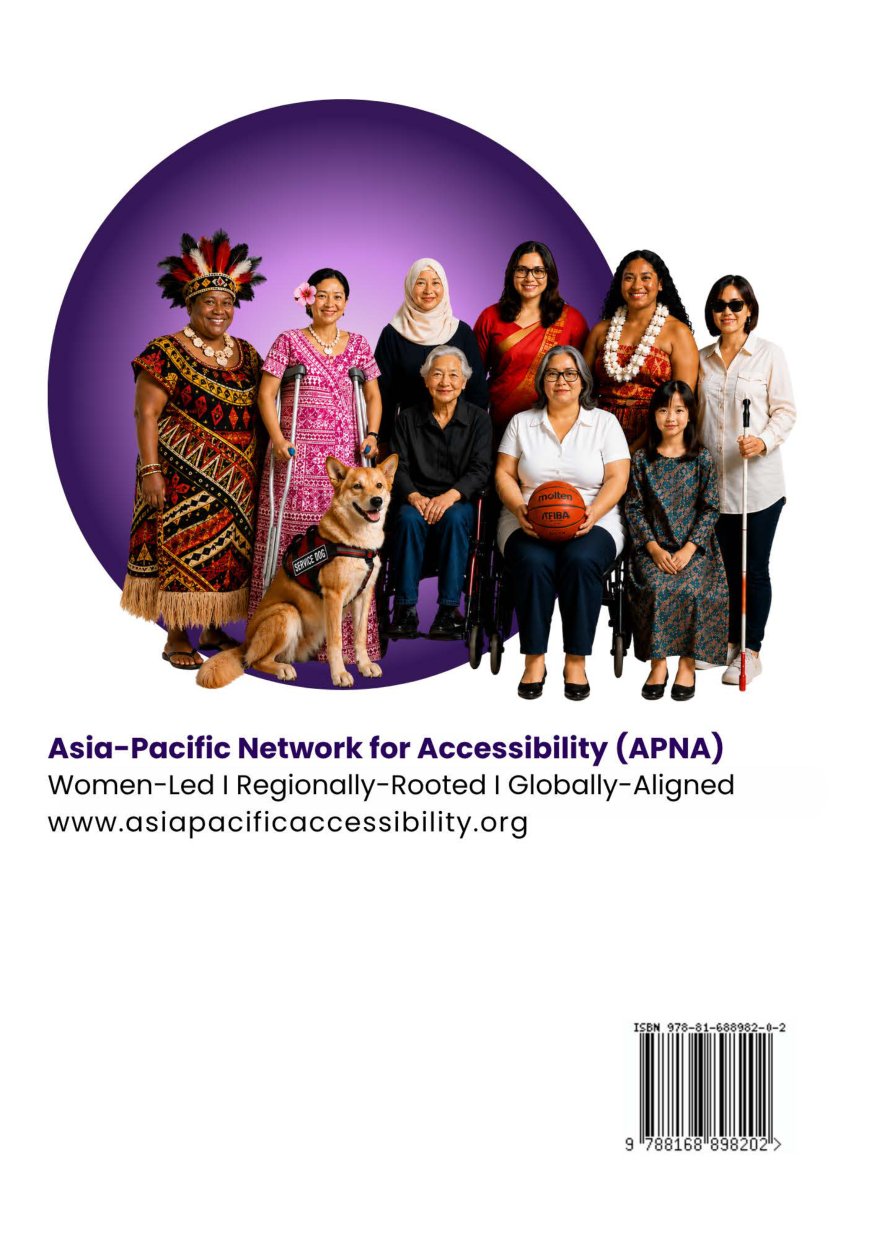
This group portrait is of nine smiling women and girls of diverse ages, ethnicities, cultural backgrounds, areas of expertise and disabilities. Seated in the first row (left to right): an older woman with silver hair swept back (beside her wheelchair is a harnessed guide dog). A middle-aged woman wearing glasses and holding a basketball is in the centre. Beside her is a girl-child, with shoulder-length hair, wearing a baju kurung.
Standing in the second row (left to right): six women and girls – of these, five are in indigenous dress, with ethnic adornment. The first woman in the second row is a mature Melanesian woman of traditional build. She is wearing a colourful ceremonial crown, fan-shaped, extending upwards and outwards in a semi-circular fashion around the top of her head, composed of numerous long, natural red, black and white bird feathers densely packed together to create a full, upright texture. Her large necklace of ivory-coloured shells complements the strikingly bold traditional pattern of her dress in natural dyes (red, brown, black), with its tasselled hem — a thick fringe of soft, natural brown fibre just above her ankles and feet in black flip flops.
The double crutch user sister beside her is wearing a large pink hibiscus over her right ear, a necklace of white shells and a long modernised pink and white dress in a traditional print. Beside her is a sister wearing a cream-coloured tudung and a black burqa. Next is a bespectacled sister with dark shoulder-length curls wearing a crimson sari with a gold border. A sister with long curly hair falling over her back, wearing a white lei and a red-yellow-black patterned lavalava stands beside a Blind young sister with short, black hair. The Blind sister, dark hair bobbed, wearing dark glasses and holding a white cane in her left hand, is the only one in the second row wearing non-indigenous clothing (a western style cream-coloured shirt with buttons down the front, collar open, black trousers, and matching cream-coloured soft oxfords – the It flat shoe trend of 2026).
Behind the group and somewhat off-centre to the left is a large purple circle whose centre emits light.
Below the image is the text: “Asia-Pacific Network for Accessibility (APNA)” followed by the tagline: “Women-Led, Regionally-Rooted, Globally-Aligned.” Under the tagline is the APNA website address <www.asiapacificaccessibility.org>. At the bottom of the page on the right is the ISBN code.